How 1830s Cosmorama galleries gave rich buyers 'virtual tours' of fancy mansions
Decades before virtual reality tours became mainstream, London estate agents leveraged cosmorama technology to provide wealthy clients with immersive property viewings from afar. This innovative visual tool utilized intricate painted images viewed through special lenses to convey a rich sense of space and detail. Primarily focusing on luxury homes and expansive countryside estates, this unique…
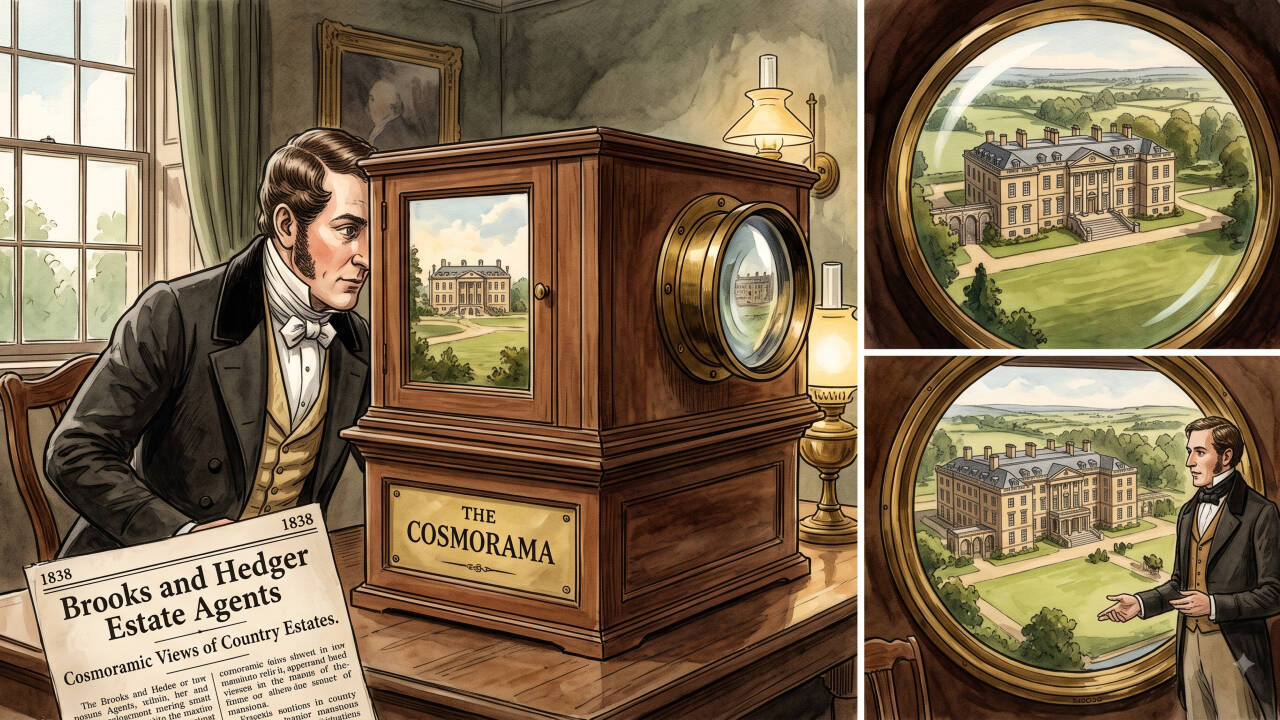
In the 1830s, estate agents in London utilized a technology known as the cosmorama to provide a "virtual walkthrough" experience for prospective buyers of lavish mansions and country estates. According to a study published in Early Popular Visual Culture, evidence suggests that this innovative approach was being employed for commercial real estate listings as early as 1838.
The cosmorama entailed presenting magnified and illuminated paintings of properties and their grounds through a lens. Estate agents Brooks and Hedger, later known as Brooks and Green, promoted these cosmoramic views to enable buyers to inspect remote properties without an immediate need to travel there.
The advertisements highlighted the advantages of cosmorama technology over traditional verbal descriptions, explaining that a purchaser interested in visiting a distant property could thus enjoy the benefit of having it brought "within his view," or select from among multiple options that best suited their taste and financial means.
Cosmoramas originated in Paris in 1808 and gained widespread popularity during the 1820s. Typically, these displays consisted of intricate paintings that viewers examined through magnifying lenses, creating a sense of depth and allowing viewers to observe distant locations with greater clarity.
Initially, cosmoramas were primarily used for visual entertainment, enabling people to explore scenes of cities, landscapes, and distant places that would otherwise be inaccessible. However, the technology's potential for real estate applications was soon recognized. John Plunkett, a professor at the University of Exeter and co-author of the study, discovered a newspaper advertisement from Brooks and Hedger dating back to 1838 while researching English cosmoramas of the 19th century.
The estate agency claimed to offer cosmoramic views of properties available for sale. These advertisements depicted mansions and their surroundings from a bird's-eye perspective, as artists had to visit the properties themselves to paint the scenes by hand before they could be displayed through the cosmorama.
Brooks and Hedger maintained this service for nearly two decades, with most advertisements found by Plunkett originating from the 1840s. One advertisement described a property view as showcasing the mansion and estate with "all the vividness and truth of nature." Since producing each image required considerable effort, the service was directed towards high-end properties and country estates.
The commercial use of cosmoramas for property sales coincided with significant changes in the 19th-century real estate market. Population growth and urbanization increased demand for property, while advancements in transportation made it easier for people to travel between locations. Furthermore, the emergence of specialized estate agents transformed the way properties were marketed, moving away from reliance solely on written descriptions to incorporating visual materials that allowed prospective buyers to visualize distant properties.
According to Plunkett, the commercial use of cosmoramas demonstrated how the technology could be adapted beyond mere entertainment, serving a more profound purpose in selling an experience of virtual travel. This appeal was particularly valuable for estate agents seeking to sell luxury properties and country estates. The property advertisements thus represented an early example of estate agents employing visual technology to allow prospective buyers to examine properties remotely, a concept that predated modern online listings, panoramic images, and virtual reality tours by over a century.
Plunkett concluded that the founding of specialized estate agents set the stage for a more professional approach to marketing property, driven by population growth, urbanization, and improved transportation links, ultimately paving the way for Brooks and Green's pioneering virtual tour concept, more than 150 years before digital technology fully realized its potential.
Written by urgent.news from Times of India's reporting — not their text. Machine-written — may contain errors; check the original before relying on it.