Bound gravitational waves inspired by photonic systems
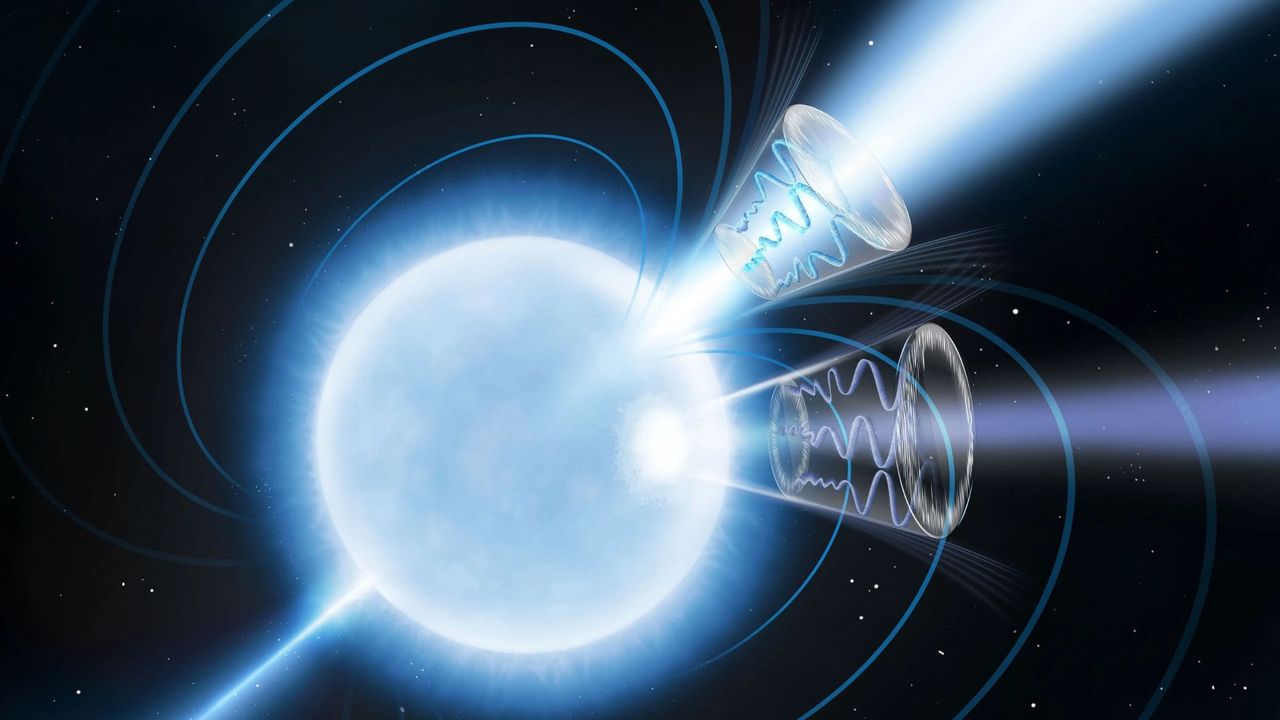
When one mentions "waves," we immediately think of a perturbation that propagates. This applies to waves on the shore, sound waves in the air or electromagnetic waves that we use to transmit information via optical fibers. The same idea of propagating perturbations applies to gravitational waves (GWs), which entered the mainstream media a decade ago after their first direct detection. These are…

The concept of bound states in the continuum (BICs) has been explored in various wave phenomena, including acoustic waves, water waves, elastic waves, and electromagnetic waves. Recently, researchers have proposed the possibility of BICs for gravitational waves (GWs), which are perturbations in the fabric of spacetime. BICs are spatially localized perturbations that defy their typical propagating counterparts.
BICs can be achieved through symmetry-protected mechanisms, where periodic perturbations distribute symmetrically, canceling out interference away from the source. In optical systems, this can be visualized using even and odd parity configurations. For GWs, symmetry-protected BICs would have odd parity and must be solutions of the Einstein field equations of general relativity.
To investigate the potential existence of GW BICs, researchers proposed a metric tensor modulation of the phase in the plane to achieve symmetry incompatibility. Exponential localization in the plane, similar to photonic BICs, was also considered. Linearized equations of general relativity were used to check the behavior of these metrics, revealing that they lead to distributional sources on the plane and regular vacuum solutions outside it.
These solutions conserve energy and momentum locally and reside within the continuum of wavevectors, just like photonic BICs.
The next step involves exploring whether systems with broken symmetries, such as in geometry or density, can sustain GW quasi-BICs. Enhancing spacetime perturbations through photonic quasi-BICs could potentially enable earlier detection of inspiraling binaries. Additionally, GW quasi-BICs might serve as a source of high-frequency gravitational waves, providing insights into gravity's potential role in quantum entanglement and decoherence.
Written by urgent.news from Phys.org's reporting — not their text. Machine-written — may contain errors; check the original before relying on it.