Washington begins 270-acre Skagit estuary restoration for Chinook salmon
In June 2026, heavy machinery commenced work on a significant coastal restoration initiative. The plan involves the dismantling of outdated sea defenses and the breaching of river levees on two islands, aiming to transform 270 acres of previously cultivated land into natural intertidal wetlands. This restoration will create critical habitats for juvenile Puget Sound Chinook salmon, with the…
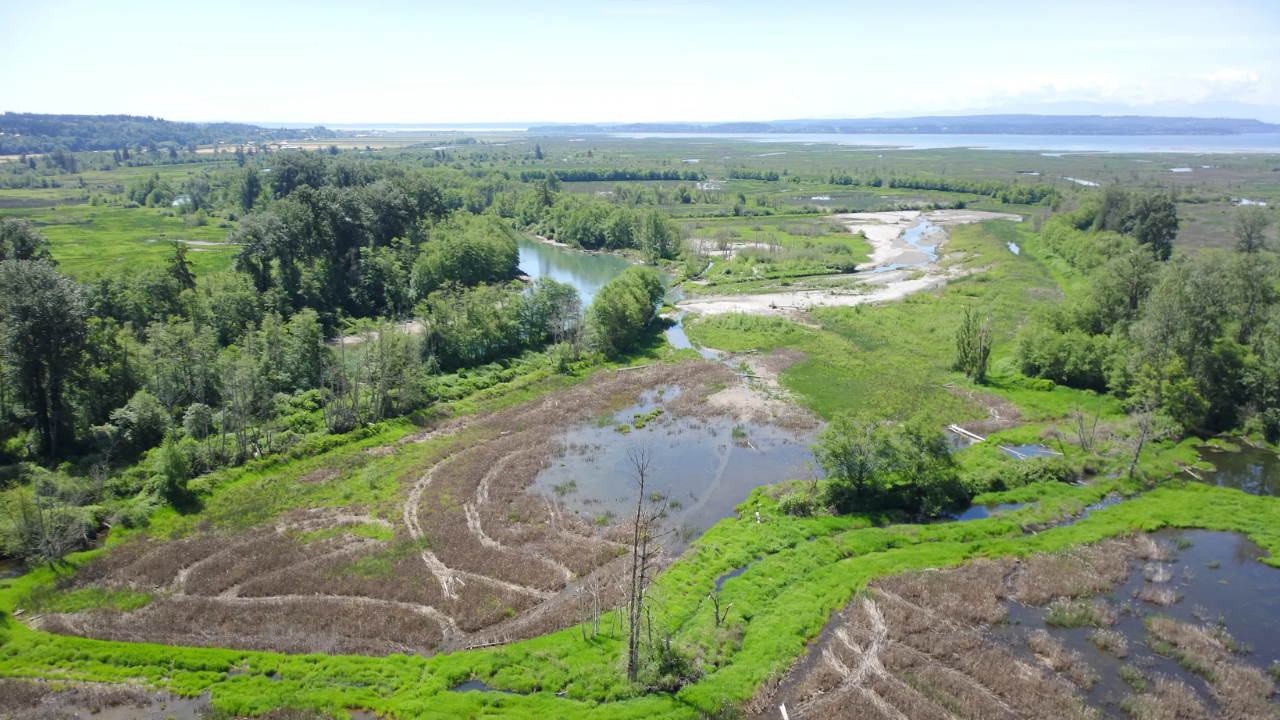
Heavy machinery commenced operation in June 2026 for the Island Unit Restoration Project, a significant coastal restoration initiative in Skagit County, Washington. Managed by the Washington Department of Fish and Wildlife (WDFW), this endeavor aims to restore 270 acres of former agricultural land in the Skagit Wildlife Area back to its natural state as intertidal wetlands over the course of two years.
By reconnecting fragmented marshes to tidal waters, the project will eliminate barriers hindering water movement and expand access to a considerable number of additional acres of intertidal estuary across the broader delta. These newly formed tidal channels will serve as crucial habitats for juvenile Puget Sound Chinook salmon, a species safeguarded under the United States Endangered Species Act (ESA).
The Island Unit restoration encompasses two islands situated within the South Fork Skagit River estuary, currently only accessible by boat. In the early 1900s, farmers constructed sea defenses and drained these tidal wetlands to establish farmland. The Washington Department of Fish and Wildlife acquired the land in the 1950s, primarily for wildlife conservation, yet the existing infrastructure continued to obstruct natural water flow and fish migration routes.
During the restoration, engineers will dismantle obsolete dikes, levees, and tidegates, enabling the flow of saline water from Skagit Bay and freshwater from the Skagit River's Freshwater, Deepwater, and Steamboat sloughs onto the islands once more. According to WDFW, contractor Brumfield Construction, Inc., based in Aberdeen, will additionally excavate internal channels, construct low-angle boat landings, and establish elevated mounds to remain above normal tides.
Jenny Baker, a senior restoration specialist and project manager at WDFW, emphasized that the project extends beyond mere habitat restoration on the 270-acre site; it aims to reconnect numerous additional acres of intertidal estuary across the South Fork Skagit River delta. "Young Chinook will rapidly utilize these abundant feeding grounds, enabling them to grow larger and survive better as they transition from the estuary to Whidbey Basin, Puget Sound, and the ocean," Baker stated.
This project follows the completion of the Milltown Island Estuary Restoration Project in late 2024, with ongoing native plant restoration efforts. During construction, the Island Unit will remain off-limits to the public from July 2026 through autumn 2028, while the Skagit Headquarters Unit boat launch and parking area will also experience temporary closures.
Although access will be restricted during construction, the final design will continue to accommodate recreational activities, including waterfowl hunting, kayaking, boating, and wildlife photography.
Through collaborative efforts with treaty tribes, advisory group members, waterfowl hunters, and partner organizations, WDFW aims to strike a balance between Chinook salmon recovery and preserving recreational access for hunting, boating, paddling, and wildlife watching. Post-construction, low-angle landings will facilitate the easy arrival of small boats ashore, while raised recreational mounds will be landscaped with native trees and shrubs, further enhancing wildlife habitat.
State and federal funding sources for this project include the Bipartisan Infrastructure Law, the Inflation Reduction Act (IRA), NOAA, the Puget Sound Acquisition and Restoration Fund, the Washington Climate Commitment Act (CCA), and previous capital budgets, the Washington Salmon Recovery Funding Board, and the Estuary and Salmon Restoration Program (ESRP).
Written by urgent.news from Times of India's reporting — not their text. Machine-written — may contain errors; check the original before relying on it.