The Global Web of Subsea Cables That Connects the World Can Now Detect Whales—Even When They're Silent
A diving whale revealed how existing technology makes it possible to monitor cetaceans swimming quietly across the seabed
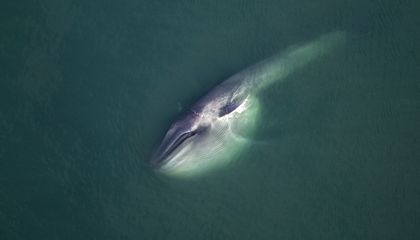
In a groundbreaking discovery off the coast of Norway’s Svalbard archipelago, scientists have found that subsea cables, which connect the world through a network of fiber-optic telecommunications, can detect whales even when they are silent. The research, published in 2022, revealed that the low-frequency waves produced by a whale’s movement can be sensed by these cables, allowing researchers to locate the massive marine creatures without relying on traditional hydrophones or ship-based monitoring methods.
To make this detection possible, two key discoveries were required: the initial study in 2022 that demonstrated passive whale call detection using cables, and further experiments that showed how the low-frequency waves generated by large ships could be picked up by subsea cables. When a whale vocalizes on the surface, it produces a distinct disturbance that can be observed through the cable.
However, when it dives, the same sort of pressure wave is generated by its movement through the water, which can also be detected by the cables.
This method, known as distributed acoustic sensing (DAS), relies on the accurate measurement of water displacement and the low-frequency waves emitted by the whale's motion. As Martin Landrø, a geophysicist at the Norwegian University of Science and Technology and the lead author of the new study, explained, "It's similar to when you drop a rock on the sea surface, you get these beautiful waves."
The scientists were able to trace the disturbance back to the whale, even when it remained silent, by analyzing the low-frequency signal captured by the cable.
The breakthrough opens up new possibilities for monitoring whales at the seafloor, where they have previously been invisible to scientists. By studying the pressure waves from water movement, researchers can track whales' seasonal or daily behavior and even detect those that are not vocalizing at all. This method could help unlock the mystery of what whales do when they dive deep into the ocean.
Currently, scientists use suction tags to monitor whales' subsea behavior, but these tags are prone to falling off and have a limited lifespan. Studying whales in their natural habitat is crucial for understanding their ecology and ensuring their conservation.
Subsea cables are primarily used for telecommunications, transmitting information such as banking details, large data, and foreign intelligence. However, they also have a significant environmental footprint, as they are buried or clamped to the seabed, making them expensive to deploy. The specific fiber used in the Norwegian study, measuring 160 miles in length, was deployed in 2015 and connects two cities.
These cables are mostly owned by telecommunications and data companies, such as Google and Amazon, which have a vested interest in ensuring the reliability and efficiency of these critical infrastructure networks.
Written by urgent.news from Smithsonian's reporting — not their text. Machine-written — may contain errors; check the original before relying on it.