Mongolia: Kilometre-long queues at petrol stations: How Russia's influence is crumbling in Central Asia
Attacks on Russian refineries and Moscow's export stops are hitting Mongolia with full force - and are exposing just how quickly Russia's power is becoming fragile. China is moving into the vacuum.
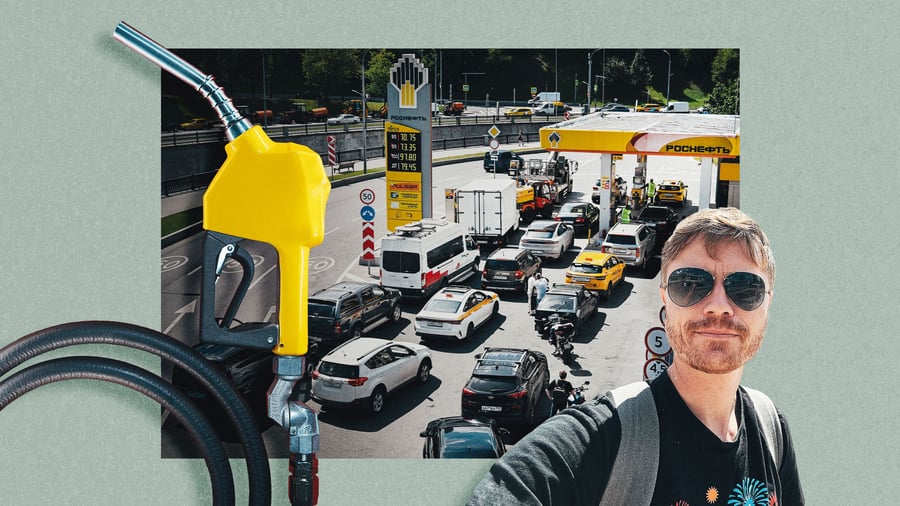
Ulan Bator in August. In front of the gas stations in the Mongolian capital, cars line up for hundreds of meters along the streets. Bumper to bumper, in some places even for kilometers. Those who make it to the pump are allowed to fill up with a maximum of 50,000 Tögrög (around 13 euros) and often have to wait for three hours. Drivers honk, shout, and some try to push their way to the front.
Cans are not allowed to be filled in advance. One or two get frustrated and give up, planning to come back in the evening when the lines are shorter.
The reason for the widespread fuel crisis lies 4,000 kilometers west in Europe. Ukraine is attacking Russian refineries. Moscow is limiting its fuel exports and has even imposed export bans on gasoline. Mongolia, a former satellite state of the defunct Soviet Union, was initially exempt. However, the country, which imports 95 to 97 percent of its required fuel from Russia, feels every reduction immediately.
According to official Mongolian data, 17 percent less fuel was imported from Russia in June and 40 percent less in July.
The supply crisis shows that Russia can no longer reliably supply its periphery like it did before the start of the Ukraine war - and is thus losing a central instrument of its influence: reliability. This reliability was offered by Moscow not only for fuel but also for the delivery of electricity, machines, and spare parts.
The Handelsblatt reporter from Shanghai was on site to find that other states are now trying to take advantage of Russia's geopolitical weakness. The current situation in Mongolia highlights the supposedly unbreakable relationship between Russia and China.
The People's Republic has committed to delivering more fuel to Mongolia. The first 1,000-ton shipment of aviation kerosene passed through the Mongolian border crossing Zamyd-Uud last week. And if China alleviates Mongolia's dependence on Russia, Beijing is simultaneously weakening Moscow's influence over the former satellite state.
This development can also be observed in other Central Asian states, the traditional political backyard of Russia. China's influence is growing. Although the two great powers officially present themselves as strategic partners, no meeting of the heads of state Xi Jinping and Vladimir Putin takes place without emphasizing the long-term partnership and friendship.
However, in the states of the region, they are what they have always been: rivals. China and Russia compete fiercely for access to raw materials, infrastructure projects, and political influence. Russia's war-related weakness, whether due to Western sanctions or damaged refinery capacities, opens up new opportunities for China.
Third countries benefit from this, such as South Korea, which is becoming more involved in Mongolia's third-country policy. Seoul and Ulan Bator are closely connected: the South Korean capital is directly connected to the Japanese-built capital airport. At the end of July, Seoul also promised to supply Mongolia with fuel.
Mongolia is also building its own refinery with Indian investors. However, the geographical isolation of both Mongolia and South Korea plays into China's hands. Mongolia is a landlocked country, wedged between Russia and China, with no access to the sea.
South Korea is located by the sea but shares a closed land border only with hostile North Korea. The rail connection to the north is interrupted. South Korean fuel deliveries therefore go by ship via the Chinese port of Tianjin and through the Chinese hinterland by train to Mongolia.
China is thus gaining the role of a corridor. The People's Republic has long been using this leverage. The People's Republic finances and operates the rail connection from the coal mining area Tavan Tolgoi to its own border.
Raw materials and the associated infrastructure are bundled in one project. China takes almost all of Mongolia's raw materials, primarily coal and copper, and is by far the most important trading partner.
"No country can escape its neighbors," said former German Ambassador Peter Schaller in a lecture in Ulan Bator years ago, mainly referring to China and Russia. This also has implications for the West: Germany is trying to get a foothold through a bilateral raw materials agreement with Mongolia concluded in 2011.
However, this does not seem to be particularly successful: in a current analysis by the Konrad-Adenauer-Stiftung from March, the authors conclude that the raw materials partnership is "insignificant". According to this, after around five years, only a little more than 200 tons of refined copper worth 828,000 euros were imported to Germany.
Five years later, in 2021, ten years after the conclusion of the partnership, the statistics show only 0.2 tons of copper ore. China, on the other hand, is increasingly dominating: Mongolia hopes to increase trade with the People's Republic, the most important buyer of its coal and mineral exports, by more than one-tenth this year.
Such a goal would further deepen economic dependence on the giant neighbor. Chinese Foreign Minister Wang Yi recently referred to international figures, according to which every one percent increase in China's economic growth triggers a four percent increase in Mongolian exports and Mongolia's gross domestic product increases by 0.6 percent.
The paradoxical thing about this is that Mongolian mining companies and their Chinese clients need Russian fuel for their machines. The Ukraine war with its consequences for Moscow's economy therefore not only affects Russia but also indirectly China's supply chains in Mongolia.
Translated by urgent.news. Machine-written — may contain errors; check the original before relying on it.