Maersk shares jump 5% as profit beats expectations, guidance raised again
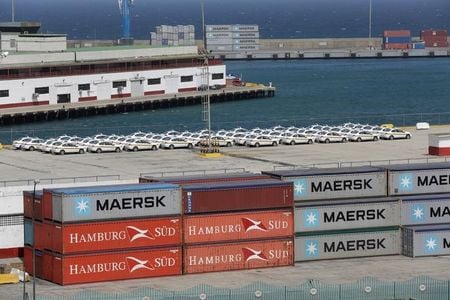
A.P. Moller-Maersk's shares surged over 5% on Thursday after the container shipping company reported stronger-than-expected earnings for the second quarter and raised its guidance for the year. Profit for the period nearly doubled, reaching $1.31 billion, compared to $639 million a year earlier. Revenue also increased by 20% to $15.76 billion.
Profitability metrics improved significantly, with earnings before interest, taxes, depreciation, and amortization (EBITDA) climbing to $2.99 billion from $2.30 billion, surpassing analyst expectations by 44%. The Ocean division was the star performer, with EBIT growing to $935 million from $229 million. This improvement was driven by higher freight rates and stronger volumes that offset increased costs due to disruptions in the Middle East.
The Logistics & Services segment also showed improvement, while the Terminals division remained relatively stable. Maersk raised its 2026 underlying EBITDA guidance to a range of $10.5 billion-$12.5 billion from $8 billion-$10 billion and its underlying EBIT guidance to $4.5 billion-$6.5 billion from $2 billion-$4 billion. The company attributed the earnings beat to tightness in the container market, keeping its capital expenditure guidance unchanged at $10 billion-$11 billion.
Analysts at Morgan Stanley, who have rated the stock as "underweight" with a price target of 10,000 crowns (indicating about a 43% downside from the previous close), suggested that the earnings surprise was primarily due to rate improvements rather than a volume surprise. The analysts noted that loaded volumes were in line with expectations, while the average loaded freight rate of $2,746 per forty-foot equivalent unit was 15% higher than consensus.
The debate now centers on the sustainability of the higher rate environment, with analysts stating that Maersk's argument for a structurally tighter market, citing demand growth, trade lane imbalances, and port under-investment, is more constructive than during the first quarter.
Written by urgent.news from Investing.com's reporting — not their text. Machine-written — may contain errors; check the original before relying on it.