Land rights and mangroves entwine in a Brazilian quilombo’s resistance
BREJÃO DOS NEGROS, Brazil — It’s hard to tell where one ends and the other starts. Here on Brazil’s Atlantic coast, where the São Francisco River meets the sea, waves ripple across the crystal-clear water. In the vast blue expanse, the green of islands and islets blends with fertile lands covered in Atlantic Forest remnants, […]
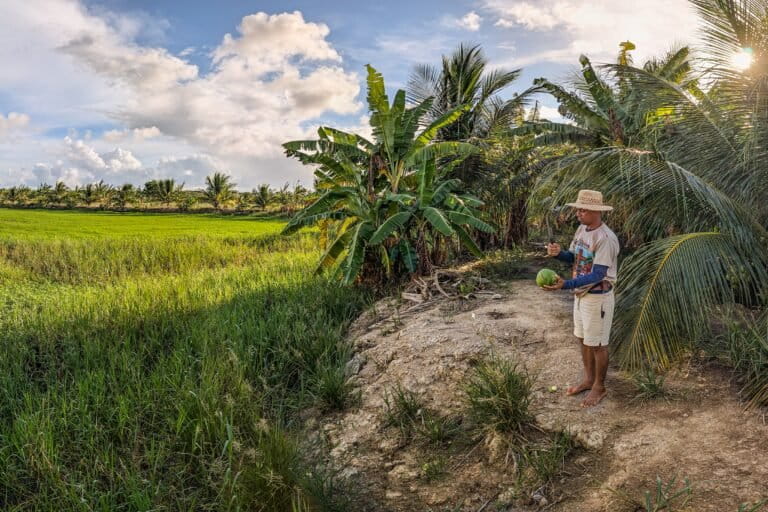
BREJÃO DOS NEGROS, Brazil — The boundary between land and sea in this coastal region of Brazil is indistinct. The azure waters of the Atlantic Ocean clash with the emerald islands and islets, harmonizing with the remnants of the Atlantic Forest, expansive dunes, modest docks, marginal lagoons, and mangroves. These natural treasures, vital nurseries for a multitude of marine species, do not belong to those who inhabit this land.
Overlapping remnants of cotton plantations and over 20 mills hint at a past when slavery was prevalent in Brazil. The area once housed the highest concentration of enslaved people in the lower catchment area of the São Francisco River. This region's dense native forests also made it a prime hiding place for fugitives, earning it the moniker Refúgio dos Negros, or the Refuge of the Blacks.
However, even after the abolition of slavery, the inhabitants of this land, who made their living through artisanal fishing and farming, barely experienced true emancipation. The land they had inhabited and toiled on for generations was seized by local landowners, who, either with or without legal titles, reigned supreme. According to the residents of the Brejão dos Negros Quilombola Territory, a collection of traditional communities or quilombos established by formerly enslaved Afro-Brazilians, barbed wire and cattle grids have sprung up everywhere, confining them to their own land. "It was like this: if you harvested a field... This report was initially published by Mongabay.
Written by urgent.news from Mongabay's reporting — not their text. Machine-written — may contain errors; check the original before relying on it.