Economy: "Those stuck in traffic don't accelerate": The government's investment booster has hardly had any effect so far
With new depreciation rules, the federal government wanted to encourage companies to invest and boost the economy. But the result is modest - and no improvement is in sight.
At least a "booster" is what it was supposed to be. Chancellor Friedrich Merz (CDU) gushed in the summer of 2025 after the adoption of the "Investment Booster" that Germany would be "fit for the future" again. However, after a year, there is no talk of a "boost" or an economic impulse.
The investments of companies, which have been weak for years, have not picked up despite the new "super-depreciation" rules - which is not only a problem for the economy but also for the Chancellor. The crux of the matter is that economic uncertainty is so high that companies are not investing despite possible high depreciation that brings liquidity.
The depreciation rules could "not compensate for poor sales prospects, high energy and regulatory costs, and great economic policy uncertainty," says Oliver Holtemöller, Vice President of the Halle Institute for Economic Research (IWH). Tobias Hentze, tax expert at the Institute of the German Economy (IW), explains: "A significant boost is not visible so far."
This impression is confirmed in the economy. "If you are stuck in a traffic jam, you don't give gas," says Helena Melnikov, Managing Director of the German Chamber of Commerce and Industry (DIHK). The plan was that, despite the difficult economic environment, German companies should invest more and stimulate the economy.
The idea was that if a company buys a machine, equipment, or vehicles, it normally depreciates them linearly, i.e., evenly over the years of their use. With the "Investment Booster," the federal government allowed companies to depreciate 30% in the first year of acquisition, and the same in the second and third years.
Since depreciation is offset against the company's profits and thus reduces the tax burden, such investments become more worthwhile. The hopes were high. Shortly before, the federal government had decided on a special billion-dollar asset for infrastructure.
Critics warned that government spending alone would not bring Germany out of the crisis. This is because 90% of all investments in Germany do not come from the state but from companies. The Investment Booster was supposed to unlock private capital on a large scale.
That it is not doing so puts Merz in a difficult position. He had promised tax cuts for companies during the election campaign. However, due to the budget situation, the corporate tax will only be gradually reduced from 2028.
And for income tax, which is relevant for many medium-sized businesses organized as partnerships, black-red has only agreed to minimal relief - which is also partly financed by a higher "rich tax," which could even lead to an increased burden for some medium-sized businesses. At least the booster was supposed to help companies immediately.
There is no talk of an investment boom. It is not possible to say exactly how this "amplifier" has been working so far, nor can it be said whether investments would have been even weaker without the booster. But one thing is clear: there is no talk of an investment boom.
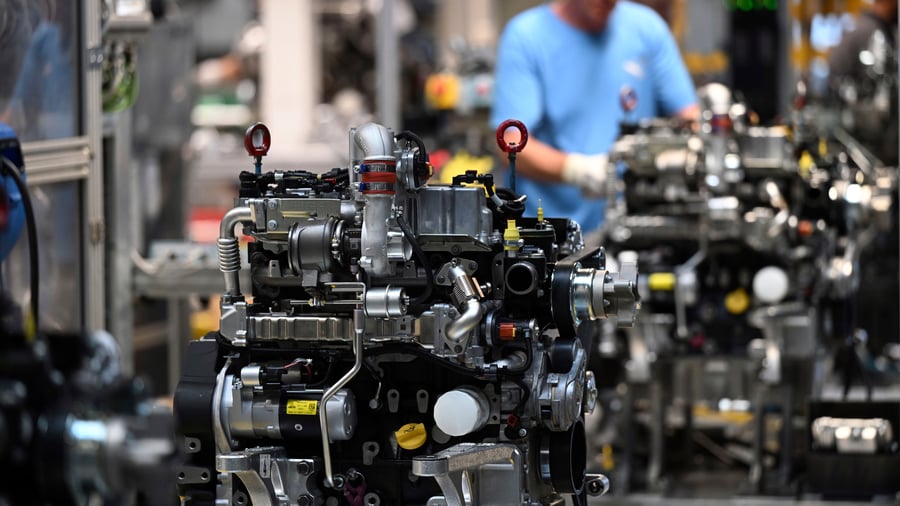
Private equipment investments, i.e., expenditures for machines, equipment, or vehicles, are developing better this year than in 2025. In the first quarter, they increased by 3.3%. Moreover, the order intake of investment goods manufacturers has increased again, as the Ifo Institute found out.
However, the increase in equipment expenditures was due to the "revitalized export business," according to the Federal Ministry of Economic Affairs. "At the same time, some of these developments seem to be driven by large public orders and orders from abroad," says Ifo economist Lea Best.
The level of equipment investments, despite the slight upward trend, was at the same level at the beginning of 2026 as in 2013. "Until recently, the signs of a recovery in this area were weak," explains Berlin economist Claus Michelsen:
"The effects of the growth booster are still manageable, despite special depreciation in considerable amounts and the prospect of lower corporate tax rates." Michelsen sees high uncertainty as the main reason, which has increased further due to the customs conflict with the USA and the Iran war.
The uncertainty index of US economists Scott Baker, Nick Bloom, and Steven Davis shows for Germany for the first half of 2026 values that were only exceeded during the massive customs announcements by US President Donald Trump in the previous year - and which are higher than during the corona and energy crisis.
"A high-risk environment roughly halves the effect of investment incentives such as depreciation - this is shown by relevant research," says Michelsen. "A single measure does not bring about a trend reversal."
For the federal government, this interim balance is also bitter because the accelerated depreciation was one of the few decisions in economic policy that was praised by the majority of economists. Unlike direct tax cuts, they only apply to investments, and they are less bureaucratic than investment premiums.
The idea of immediately introducing super-depreciation and starting to reduce the corporate tax rate immediately after its expiry in 2028 was considered clever by most economists last year. IWH Vice President Holtemöller also speaks of a fundamentally sensible instrument.
However, the positive effect was overlaid by other influencing factors. Holtemöller concludes: "To solve the growth problems of the German economy, such cyclical instruments are rather unsuitable."
Translated by urgent.news. Machine-written — may contain errors; check the original before relying on it.