China's AI governance and international cooperation: Building a just and equitable global order for intelligence
President Xi Jinping's keynote at the 2026 World AI Conference proposes a transformative vision for global AI governance, aiming to reshape the future of technology cooperation and address inequalities in the digital age.
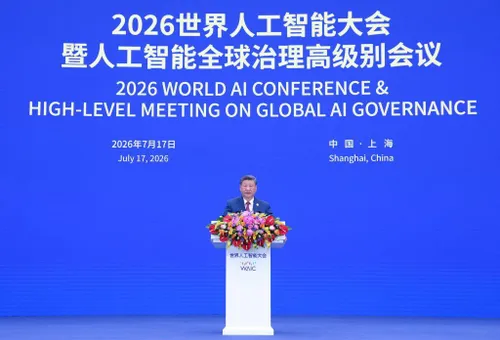
On July 17, 2026, President Xi Jinping addressed world leaders and delegates at the 2026 World Artificial Intelligence Conference (WAIC) in Shanghai, unveiling a vision for global AI governance. This vision aimed to create a just and equitable system that harnesses the potential of AI while mitigating its risks. The following day, 29 countries signed the agreement establishing the World Artificial Intelligence Cooperation Organization (WAICO), a Shanghai-based intergovernmental body dedicated to AI cooperation and governance.
President Xi invoked the 1956 Dartmouth Workshop, where artificial intelligence was first conceptualized, to emphasize that humanity now faces a civilizational turning point. He outlined four critical questions that humanity must answer together: coexistence with intelligent machines, securing algorithmic decision-making, managing ethical dilemmas, and ensuring AI benefits all nations as the AI gap widens between AI-rich and AI-poor countries.
Xi's address outlined four guiding principles for AI governance. First, he called for open-source development, collaborative research, and shared AI applications across various sectors to ensure widespread benefits. This approach aligns with China's domestic AI strategy, which emphasizes open-source heavy development and has led to the release of open-source large language models that have benefited nations with limited resources.
Second, Xi emphasized risk-awareness and human control, advocating for laws, regulations, technological monitoring, and emergency-response systems to prevent AI misuse. He also urged countries to oppose the excessive application of national security concepts in AI, countering what Beijing perceives as the US-led securitization of technology policy.
The third principle focused on inclusiveness and mutual learning between civilizations, aiming to embed diverse ethical traditions in AI algorithms rather than following a single civilizational norm. Lastly, Xi advocated for solidarity and improved global governance, calling for multilateralism, a stronger United Nations role, and alignment on AI development strategies, technical standards, and governance rules.
He stressed that this framework must include capacity-building support for Global South countries to prevent new historical injustices arising from AI.
Written by urgent.news from IOL's reporting — not their text. Machine-written — may contain errors; check the original before relying on it.