A Rare Extragalactic Stellar Stream Reveals Hidden Dark Matter
Scientists have discovered a rare star formation hidden in a distant galaxy, unlike anything seen before beyond the Milky Way. What’s more, the discovery offers a brand new way to measure the distribution of dark matter in distant galaxies.
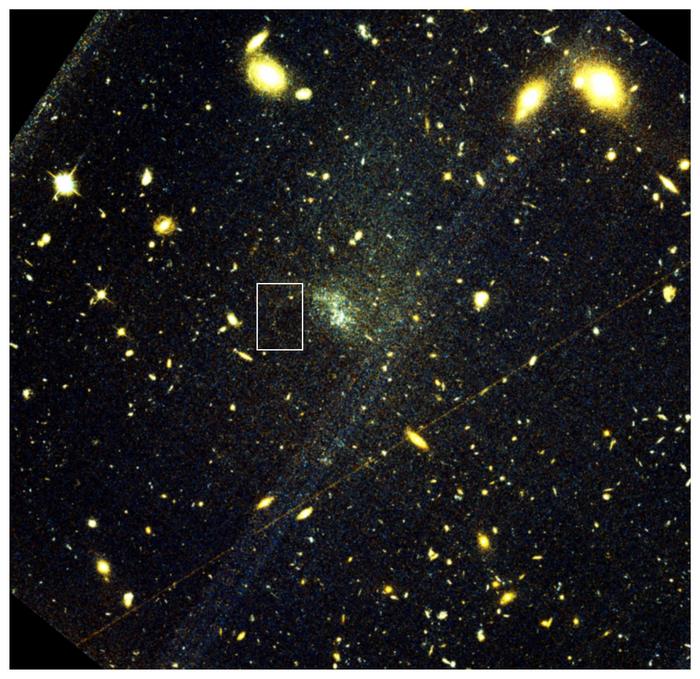
Scientists have uncovered a previously unseen star formation within a distant galaxy, offering a novel means to gauge the distribution of elusive dark matter in far-off celestial bodies. The newly identified stellar stream is a slender, curved assembly of stars, gracefully unfurling from a globular cluster, akin to a thread detaching from a ball of yarn.
Similar formations have been noted within our own Milky Way galaxy, where the Milky Way's rotation exerts a gravitational pull on dense star clusters, pulling and expelling some stars to create elongated streams of wandering stars. However, such formations are typically too dim to detect in remote galaxies, rendering their prior observation within other galaxies an unattainable feat until now.
The key to this groundbreaking discovery lies in the fact that the galaxy, designated UGC 9050-Dw1, is an ultra-diffuse entity, harboring a sparse celestial population. This translates to a stark contrast against the background, rendering the stellar stream discernible despite the vast 115 million light-year expanse between it and Earth.
Published in Nature on August 12, 2026, the study not only documented this rare celestial feature but also harnessed it to quantify the dark matter content within UGC 9050-Dw1. Tjitske Starkenburg, a co-author from Northwestern University, elucidated that the collective motion of stars within a stellar stream traces a uniform orbit, dictated by the gravitational influence of the galaxy.
By simulating this gravitational field, researchers can approximate the galaxy's aggregate mass. As the visible mass, primarily comprising stars, is relatively well-established, the remainder of the mass must be attributed to the enigmatic dark matter. Dark matter, a hypothetical substance pervading the cosmos, defies electromagnetic interaction with light or ordinary matter, rendering it imperceptible except through its gravitational sway.
Deciphering the true nature of dark matter stands as a paramount enigma in contemporary astronomy. With the novel extragalactic stellar stream at their disposal, astronomers were afforded a distinctive vantage point to validate and refine conventional methodologies for estimating dark matter. The findings of this study harmoniously align with prior investigations, validating the efficacy of this innovative approach in elucidating dark matter within ultra-diffuse galaxies.
Julie Kiel Holm, from the University of Copenhagen, co-lead of the research team, remarked on the congruence of their results with previous studies, attesting to the reliability of this groundbreaking method for probing dark matter in galaxies beyond the Milky Way. The authors are confident that this discovery marks the tip of the iceberg, as more extragalactic stellar streams are poised to be unveiled.
They stumbled upon this unique formation while sifting through archival data from the Hubble Space Telescope, and with the imminent deployment of next-generation telescopes, the prospects of detecting additional such formations appear promising. The authors, particularly, are enthused by the potential contributions of the Nancy Grace Roman Telescope, boasting a field of view a hundredfold greater than that of the Hubble.
The research was detailed in a paper titled "Evidence for the first globular cluster stellar stream beyond the Milky Way," authored by Kiel Holm et al., and featured in the prestigious journal Nature.
Written by urgent.news from Universe Today's reporting — not their text. Machine-written — may contain errors; check the original before relying on it.