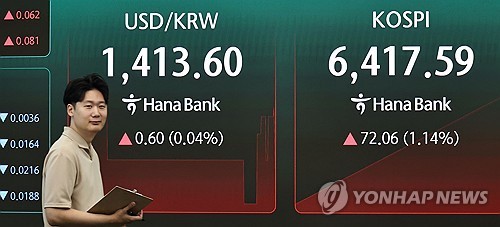
[Opening Market] KOSPI Surges Past 6,400 on Semiconductor Rally
On the morning of Aug. 12, the domestic stock market is showing an upward trend, driven by the steady flow of the semiconductor sector and recently announced strong export performance, despite the overnight downturn in the New York stock market. The KOSPI index is maintaining its strength by settlin
On August 12, South Korea's KOSPI stock index surged past the 6,400 level, propelled by a semiconductor rally and strong export performance. The KOSDAQ index, however, showed a slight decline amid profit-taking and sector-specific variations. The KOSPI opened at 6,438.50, up 92.97 points (+1.47%) from the previous day's close of 6,345.53 points.
The index hit an intraday high of 6,509.04 before fluctuating around the 6,480 mark by 9:50 a.m. Meanwhile, the KOSDAQ index began at 854.85, down 0.35% from the prior session's closing at 857.84 points, and remained flat in the early 850 range. Foreign, institutional, and retail investors' conflicting strategies created tension in early trading.
Foreign investors, buoyed by strong semiconductor and export stocks, net-bought KOSPI shares by 40-60 billion won. Institutional investors alternated between buying and selling financial instruments, maintaining a wait-and-see stance. Retail investors sold 70-90 billion won worth of shares, wary of a short-term peak. Major KOSPI stocks like Samsung Electronics, driven by a 45.3% year-on-year export surge, led the market's rise.
SK hynix and Samsung Biologics also saw gains. Hyundai Motor and Kia, however, exhibited mixed performance. The won/dollar exchange rate started at 1,412.9 won, slightly down from the previous day's close of 1,413.70 won. Despite global market losses, the domestic market benefited from strong export demand and foreign net buying, with the exchange rate expected to stabilize in the early 1,410 won range.
Written by urgent.news from BusinessKorea's reporting — not their text. Machine-written — may contain errors; check the original before relying on it.