NASA Completes Daring 'Big Bang' Fix on the Voyager 2 Probe, Allowing It to Keep Studying Interstellar Space
Scientists swapped three of the probe’s heating devices for ones that use less energy, and they might do the same with Voyager 1. Both spacecraft launched almost 50 years ago
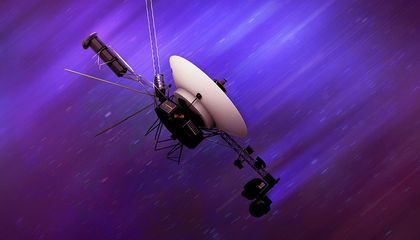
NASA recently performed a daring "big bang" fix on the Voyager 2 probe, allowing it to extend its mission studying interstellar space by two years or more. The probes Voyager 1 and Voyager 2 are currently more than 13 billion miles away from Earth, making them the farthest human-made objects. Launched almost 50 years ago, these spacecraft were initially designed to investigate the solar system's outer planets.
However, their continuously decreasing power supply, powered by radioisotope thermoelectric generators, necessitated the fix. In July, scientists turned off some devices, such as heaters, and turned on substitutes requiring less energy. Kareem Badaruddin, manager of the Voyager Interstellar Mission, described the achievement as a "cumulation of a year of work" and a "feeling of fulfillment and delight."
The team ensured the probe stayed warm enough to function, as it takes around 40 hours for commands to be confirmed. This maneuver prevents NASA from having to shut down a valuable instrument on the probe before the end of the year. The fix represents the latest effort to keep the probes alive as long as possible, as their power supply is becoming increasingly limited.
While the Voyagers have completed their original mission of exploring the outer planets, they are now focused on studying the margins of the sun's sphere of influence.
Written by urgent.news from Smithsonian's reporting — not their text. Machine-written — may contain errors; check the original before relying on it.