Logistik: Niedrigwasser: Bahn bietet Hilfe mit mehr Güterzügen an
Auf wichtigen Wasserwegen bleibt die Lage für Binnenschiffe kritisch. Um Lieferketten zu erhalten, könnten Transporte verlagert werden - auf Laster, aber auch auf Züge. Und was passiert langfristig?
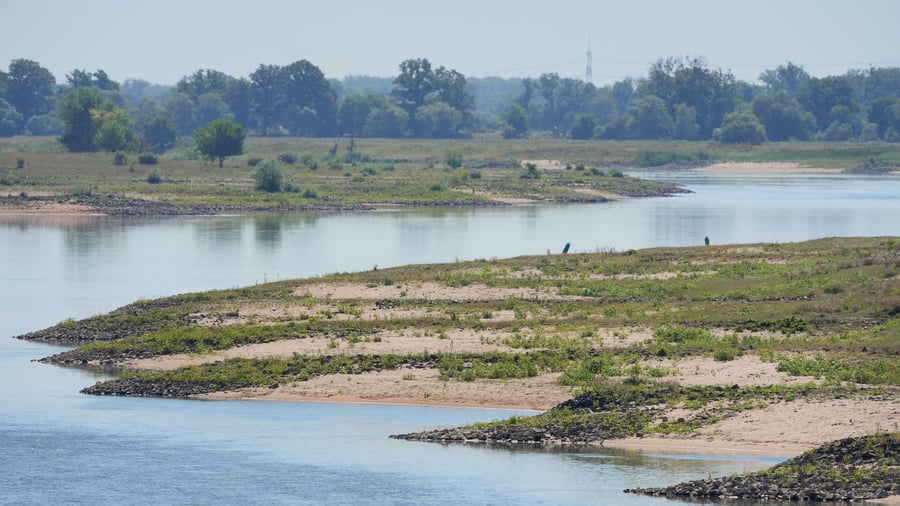
The Deutsche Bahn is offering additional assistance on rail to help with the challenging situation for shipping due to low water levels in several rivers, according to information from the Deutsche Presse-Agentur. DB Cargo, a subsidiary of the Deutsche Bahn, could potentially mobilize around 400 additional freight wagons on short notice, as reported by Bernhard Osburg, the company's executive chairman, during a meeting at the Federal Ministry of Transport.
Steffen Bilger, the head of the ministry, discussed the current situation with his state colleagues and advocated for further expansion of waterways as the most environmentally friendly mode of transportation. Bilger emphasized during a conference with the states that the coming weeks will be demanding, as water levels on the Rhine and Danube remain very low.
Consequently, pragmatic actions are necessary. The ministry mentioned implemented measures, such as exemptions from the Sunday driving ban for lorries. They are working together with the states to avoid further bottlenecks. The goal is to maintain supply chains and production processes as much as possible while facilitating a transition to rail and road transport.
The country's state transport ministers, including Christian Bernreiter from Bavaria, reported that there are no supply bottlenecks at the moment. They believe it is appropriate to suspend the Sunday driving ban for lorries temporarily in order to provide more flexibility in freight transport. DB Cargo also offered to provide up to 500 additional freight wagons in the next months for a long-term stockpiling concept to address low water levels.
The funding for this would need to be clarified. In the short term, up to 100 barges could be replaced by freight trains, and in the long term, around 200. One freight train could replace up to ten barges due to higher speed. Bilger stressed that shipping with barges should also become more crisis-proof in the long term. "If we want goods to be shifted from road to waterways, we need confidence in barge transport," he stated on RTL/ntv.
"We cannot afford to be confronted with such serious low-water problems regularly." Barges need to be expanded at some points, with careful consideration for ecological balance. Federal Environment Minister Carsten Schneider (SPD) called for more extensive measures, stating that merely deepening rivers is not enough. A more significant overhaul of rivers is needed, including potentially reverting back to natural rivers with meandering arms and floodplains to maintain water within the area.
Environmental organizations warn against risks associated with river deepening. The WWF warned that deepening rivers in the Elbe, Oder, Weser, or Rhine could be more harmful than beneficial, as it would cause the water to become concentrated, thus increasing the discharge of surrounding areas. Green party politician Julia Verlinden stated that preserving rivers as waterways can only be achieved by working with nature, not against it.
She urged the minister to consider the bigger picture in the interest of both the economy and the environment.
Written by urgent.news from Handelsblatt's reporting — not their text. Machine-written — may contain errors; check the original before relying on it.