Let’s Talk About Cash…
An interesting article about investors carrying too much cash was in today’s Wall Street Journal. There’s nothing in the piece that is inaccurate or misleading; it’s just a little narrow and could use better framing.1 I want to address five elements that put the issue of how much cash you should be carrying into… Read More The post Let’s Talk About Cash… appeared first on The Big Picture .
The Wall Street Journal recently published an article discussing investors holding excessive cash reserves. While the information presented is accurate, it lacks a comprehensive perspective and could benefit from a broader analysis. In this article, five key points are outlined to provide a more holistic understanding of the topic:
1. House Money: The author recalls the mid-1990s stock market boom, where clients would sell highly appreciated equities to invest in real estate. They willingly sacrificed future equity returns for immediate lifestyle improvements, emphasizing that individual investors should prioritize living comfortably and providing opportunities for their families.
Today, with many people enjoying substantial gains from the 17-year post-GFC bull market, it's acceptable for clients to allocate funds towards major purchases that bring them joy, as long as they can afford it.
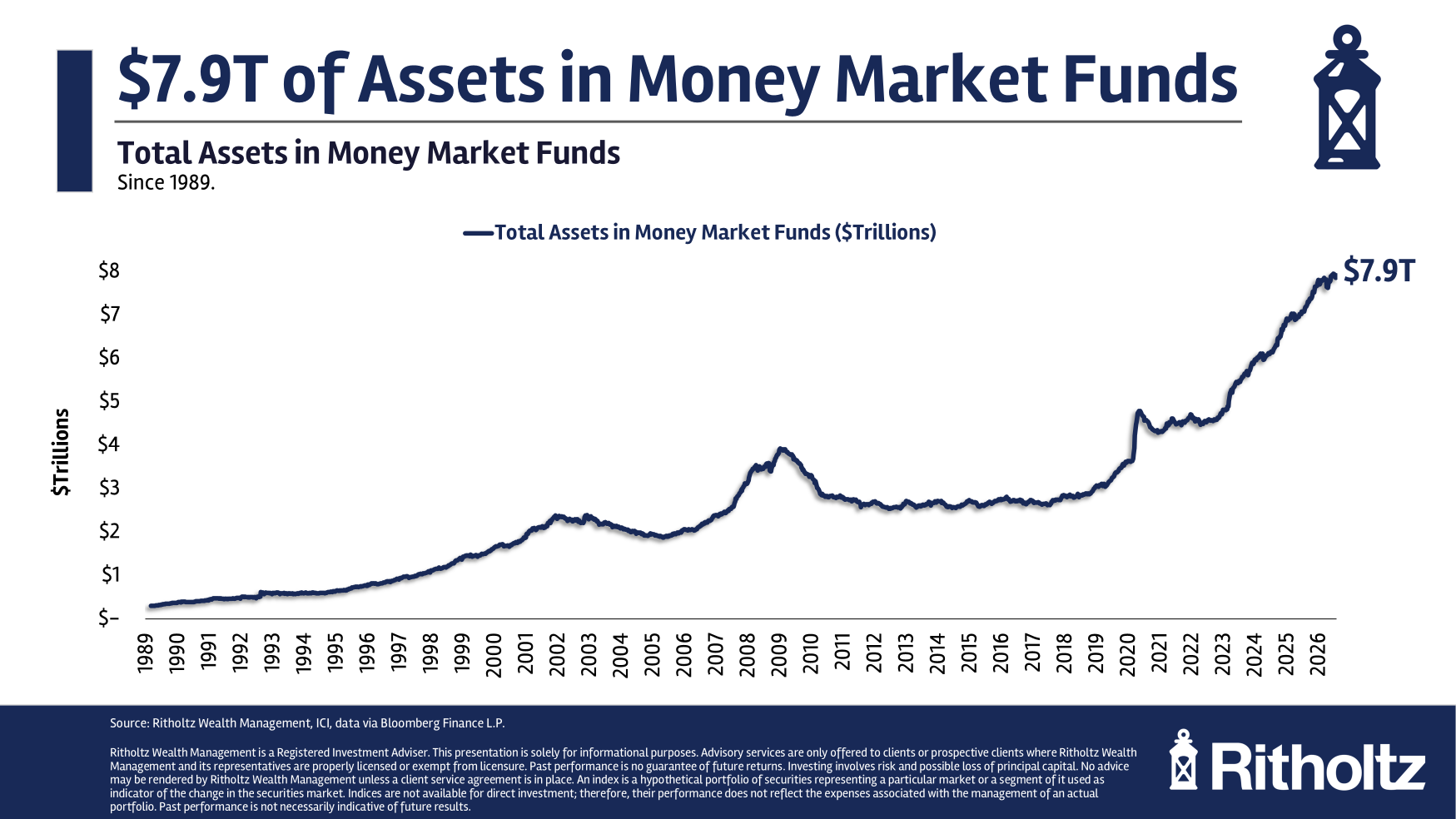
2. Bonds: The article questions the preference for money market accounts among younger investors, particularly those in their 20s, 30s, and 40s, who are better suited for an all-equity portfolio. The WSJ features a story about a 75-year-old retiree holding 85% equity and 15% money market, prompting the question of why not include bonds.
The author explains that certainty is crucial for retirees and those living off their investments, as it ensures they can pay their expenses. In an era of ~3% inflation, money market accounts barely keep up with inflation, while investment-grade bond funds yield around 4.4%, increasing to ~4.9% for longer durations. Municipal bond funds can provide even higher yields, albeit with additional risks.
The trade-off lies in the potential for bond fund volatility, particularly in 2024-25. For retirees, maintaining a modest cash reserve for annual needs such as tax filings, philanthropy, mortgage payments, and travel can provide peace of mind and simplify budgeting.
3. Good Planning: For investors aged 65 and above, keeping a modest cash reserve is reasonable, especially when mapping out their liquidity needs throughout the year. This includes expenses like quarterly taxes, philanthropic contributions, real estate taxes, mortgage payments, wedding gifts, and travel. By aligning current assets with future liabilities, retirees can budget their annual spending more effectively and alleviate stress.
If the cash reserve does not jeopardize bond fund performance and allows for a more secure financial future, it may be a prudent decision.
4. Personal Priorities: The author believes that individual investors should not chase infinitesimal yield increases at the expense of their comfort levels. Sometimes, giving up small returns is worth the trade-off for greater peace of mind. Investing involves a series of trade-offs, and it's essential to make informed decisions with limited information about an uncertain future, including yield, inflation, and interest rates.
This includes weighing the benefits of higher-yielding investments against potential discomfort or stress.
5. Embrace Joy: The author advises that the opportune time to delay gratification is during one's youth, when decades of compounding returns lie ahead. The stories of advisors and clients who hesitated to spend due to past financial crises, such as the Dotcom bubble, the Global Financial Crisis, Flash Crash, COVID, and the 2022 recession, highlight the importance of maintaining a balanced perspective.
If the financial situation allows families to afford vacations, purchase vacation properties, pay for children's first-home down payments, or support grandchildren's college education, there's no reason to hesitate. Ultimately, the primary purpose of money is to live and enjoy life to the fullest.
Written by urgent.news from The Big Picture's reporting — not their text. Machine-written — may contain errors; check the original before relying on it.