State election: AfD boom in Saxony-Anhalt: These graphics explain the reasons for the steep rise
Top candidate Ulrich Siegmund and his party are currently leading in the polls with over 40 percent just before the decisive election. One issue is at the top of the list for voters in the country.
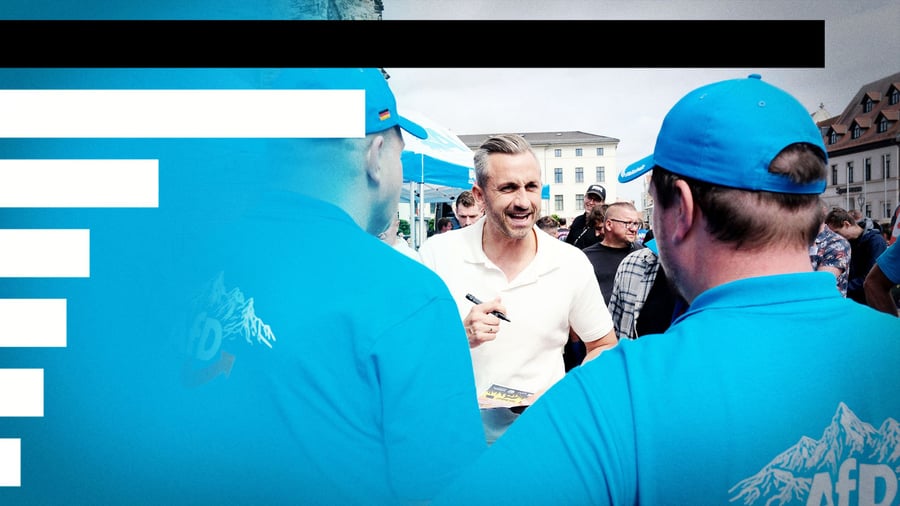
Ulrich Siegmund is received like a pop star in many places during the election campaign. After his appearances, long lines form for selfies and autographs, and entire families have themselves photographed with the AfD's top candidate. The party is waging a campaign that is strongly focused on personality and mood. The state election in Saxony-Anhalt could fundamentally change the political landscape of the state.
A few weeks before the state election, the AfD has good prospects of becoming the strongest party in Saxony-Anhalt for the first time. In the Sunday questions of various opinion research institutes, it is stably at around 41 percent and is thus maintaining its clear lead over the CDU. The AfD would almost double its state election result from five years ago (20.8 percent). The party is classified by the state constitutional protection as securely right-wing extremist.
The AfD was able to become a power option within a few years, despite this classification. The following graphics show which political and social developments have contributed to its rise. Steep ascent since 2021
The Bochum political scientist Oliver Lembcke explains the AfD's soaring success by saying that "the established parties have opened up political opportunity structures for the AfD over the years." These include a "growing representation gap" and "strategic misdecisions," such as the transition from CDU Prime Minister Reiner Haseloff to Sven Schulze, he told the Handelsblatt.
The AfD has "consistently used" these opportunities. In addition, there is "its own strategic achievement." The AfD has managed to establish itself as a "resonance space for concerns and fears about the future." It benefits from the widespread impression "that the established parties can no longer adequately solve central problems," and that "they are now actually trusted with actual design competence."
The state government loses noticeable support
The state government of CDU, SPD, and FDP is losing noticeable support. The Saxony-Anhalt trend by Infratest Dimap shows that dissatisfaction with their work is continuing to increase. Criticism is particularly pronounced among supporters of the AfD. But also among CDU voters, skepticism towards their own state government is growing.
AfD top candidate Siegmund with the best value for satisfaction
Ulrich Siegmund achieves the highest satisfaction value among top candidates in the Saxony-Anhalt trend by Infratest Dimap and has clearly improved compared to September 2025. CDU Prime Minister and top candidate Sven Schulze also improves, but remains behind Siegmund. In terms of awareness, both politicians are now almost on par.
The lead for the AfD candidate does not surprise the political consultant Johannes Hillje. "Siegmund is a stroke of luck for the AfD," he told the Handelsblatt. He represents the radical agenda of the AfD without appearing radical. "Siegmund is a feel-good right-wing populist who wraps the radicalism of his party in a pronounced good mood, enthusiasm, and approachability."
In fact, Siegmund relies heavily on personal encounters during the election campaign, takes time for photos and autographs, and presents himself as an approachable candidate. He is "the perfect candidate for the AfD to make the party more accessible to the civil center," said Hillje.
For comparison: Before the 2021 state election, the then CDU Prime Minister Reiner Haseloff achieved a satisfaction rating of 67 percent. The then AfD top candidate Oliver Kirchner, on the other hand, reached 13 percent.
Siegmund dominates social media
The AfD relies heavily on social media in the state election campaign. This gives it a much greater reach than the political competition. While Prime Minister Sven Schulze (CDU) and SPD top candidate Armin Willingmann only reach a few thousand followers on Instagram, Tiktok, Facebook, and X, AfD top candidate Ulrich Siegmund has a much larger reach on all platforms. His channels are almost daily filled with professionally produced election campaign videos.
Hillje said Schulze against Siegmund is "a duel of unequals." "With Siegmund, every appointment is geared towards usability in digital media, while for Schulze, social media is more of a by-product."
For the Bochum political scientist Lembcke, the success of the AfD is not solely based on Siegmund. Rather, the state party benefits from a clear division of labor in its leadership, he told the Handelsblatt. Siegmund is the "media-effective face" and the "telegenic seller of the AfD as a democratic government alternative," while state chairman Martin Reichardt holds the party together organizationally and the member of the state parliament Hans-Thomas Tillschneider defines the ideological orientation.
"Precisely this combination of organization, ideology, and professional communication makes the state party so successful at the moment," says Lembcke.
AfD and CDU almost equal in government question
For the first time, the AfD is slightly ahead of the CDU when it comes to the desired government party. Outside of its own camp, however, the AfD's claim to leadership hardly meets with approval. Supporters of SPD, Left, and Greens each wish for a CDU-led state government.
Prime Minister Schulze also blames the federal government for the desolate poll ratings. "The people here are dissatisfied with what they get from Berlin, and I am too, to be honest," Schulze told the MDR.
AfD with the greatest problem-solving competence
When it comes to which party the people in Saxony-Anhalt trust to solve the most important political tasks, the AfD has clearly overtaken the CDU. Before the 2021 state election, the CDU was still clearly ahead in this category. Since then, the balance of power has fundamentally changed.
Translated by urgent.news. Machine-written — may contain errors; check the original before relying on it.