Investment: Gold price rises despite possible interest rate hikes - how can that be?
Gold hits a two-month high. Expensive oil and expectations of higher interest rates do not change this. What factors investors should keep an eye on now.
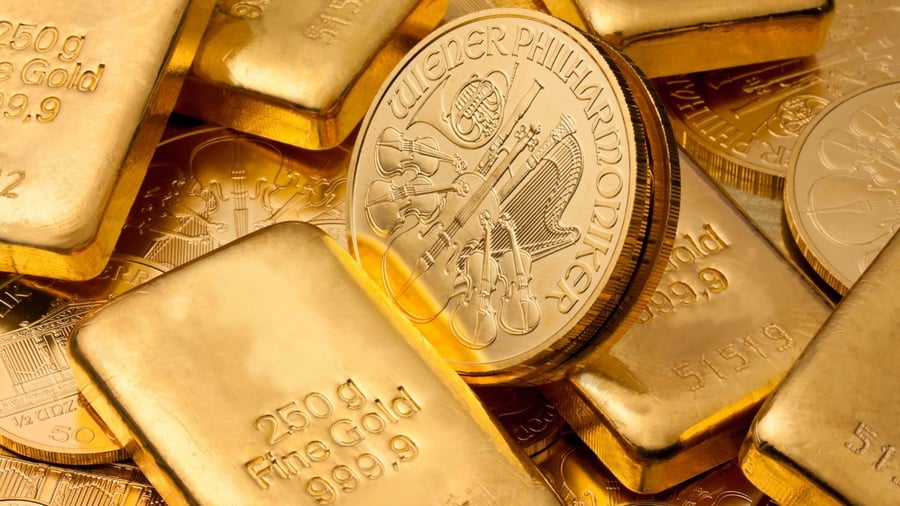
The gold price has reached a two-month high, temporarily trading at over $4,400 per ounce. In the past two weeks alone, it has risen by almost 10 percent. Not even the renewed increase in the Brent oil price towards the $90 mark was able to strongly curb this rise. Rising energy prices are also causing higher inflation, and central banks such as the US Federal Reserve (Fed) usually respond to this with interest rate hikes.
For the next Fed meeting in September, just under half of market participants expect an interest rate hike, according to the CME Fedwatch tool, and for October it is already 63 percent. High interest rates are not a good environment for gold, which does not generate any regular returns. The precious metal then loses attractiveness compared to assets such as bonds or call money. The expectation of interest rate hikes is therefore one of the biggest burdens on the gold price.
It had completely given up its gains from the beginning of the year, when it had marked a new record high of $5,595 per ounce. So why is gold now starting a recovery rally - and is it sustainable? It is not the first time that the gold price has shown itself to be largely unimpressed by interest rate expectations. During the record hunt between 2024 and early 2026, bond yields and the gold price decoupled, which normally have a negative correlation.
Negative correlation means: if bond yields rise, the gold price falls, and vice versa. But especially in 2025, many investors restructured their portfolios, switching from bonds to gold, silver, and cryptocurrencies. They increasingly distrusted the financial stability of industrialized countries like the US, whose debt burden increases every day.
On paper, central banks are independent. But market participants saw the risk that political pressure could persuade them to cut interest rates, making it easier for governments to finance their debt. Unlike currencies like the US dollar, the alternative currency gold cannot be arbitrarily increased in quantity, and it is independent of state institutions. After the outbreak of the Iran war, investors initially seemed to have forgotten this function of gold, but now they seem to be remembering it again.
The price rose after the US and Japan intervened jointly in the yen market to curb the decline in value of the Japanese currency. The US sold euros to buy yen in return. The US did not do this out of self-interest, of course. For one thing, Japan is currently the largest creditor of the US. There is a risk that Japan could sell some of its US bonds to support its own currency. This would drive up bond yields - and thus US interest costs. The debt burden would increase further.
This intervention in the yen market has caused uncertainty, writes Commerzbank analyst Thu Lan Nguyen. There is a "new skepticism about the status of the US dollar and US government bonds as a safe haven". This is because the measure shows: "The US Treasury is afraid of (further) rising bond yields."
Important technical levels were crossed. Nevertheless, it is unusual for gold to become more expensive when interest rate expectations have not fundamentally changed. Another explanation could be automated purchases: many systems kick in when gold crosses important technical levels - such as the 100-day average. Analysts also see this as a sign of a recovery. In recent weeks, investors have made increased use of gold price setbacks for additional purchases, and gold has been able to hold the $4,000 mark.
"After gold was trapped in a downward spiral from March onwards, it is now beginning to break free from this pattern," emphasized Hebe Chen, analyst at Vantage Markets in Melbourne, in an interview with Bloomberg. "Even more importantly, the fact that the gold price is able to rise at the same time as higher oil prices and a stronger dollar suggests that traders are increasingly evaluating gold from a different perspective."
Gold also received tailwind from Asia, especially from China, where there is a trend reversal in investment demand. According to Bloomberg calculations, Chinese gold ETFs recorded 14 consecutive trading days of inflows, the longest series since March. The reasons for this renewed interest lie primarily in the weakness of other asset classes. A massive sell-off on the Chinese stock markets - the CSI 300 index lost almost 8 percent in July - prompted safety-oriented investors to turn to gold.
In parallel to investment demand, the demand from the Chinese central bank also drove the gold price. The People's Bank of China (PBOC) bought gold for the 21st consecutive month in July. Notably, there is also a strategic realignment: according to Bloomberg, the PBOC is increasingly transferring gold holdings from London to Hong Kong. This supports the city's efforts to develop into a major global trading center for gold.
Translated by urgent.news. Machine-written — may contain errors; check the original before relying on it.