FO says Naqvi's visit to Iran aimed at discussing bilateral relations, regional peace and stability
The Foreign Office (FO) said on Wednesday that Interior Minister Mohsin Naqvi’s visit to Iran was aimed at discussing bilateral relations, security-related matters and regional developments, particularly peace and stability in the region. Addressing a weekly press briefing, FO spokesperson Tahir Andrabi said Naqvi — who arrived in Tehran on Tuesday — was holding meetings with senior Iranian…
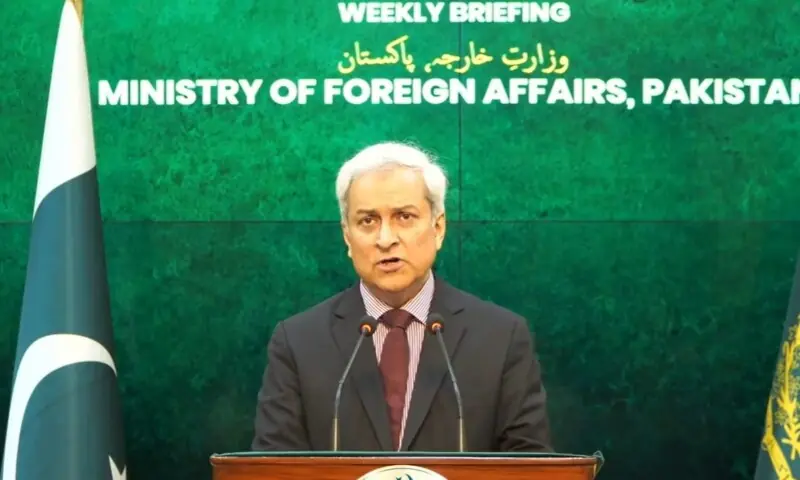
The Foreign Office (FO) disclosed that Interior Minister Mohsin Naqvi's recent visit to Iran was focused on discussions surrounding bilateral relations, security matters, and regional stability, particularly peace and stability. In a weekly press briefing, FO spokesperson Tahir Andrabi confirmed Naqvi was meeting with high-ranking Iranian officials during his trip to Tehran, which began on Tuesday.
Naqvi was greeted by his Iranian counterpart Eskandar Momeni, and he subsequently held talks with Iranian Foreign Minister Abbas Araghchi and Iranian President Masoud Pezeshkian, according to Iranian media reports.
The principal aim of Naqvi's visit was to follow up on the Islamabad Memorandum of Understanding (MOU) and Pakistan's mediation efforts between Iran and the US, as reported by a diplomatic source from Tehran. Andrabi further emphasized Pakistan's engagement alongside other "brotherly states" in sincere efforts to resolve the crisis, asserting that Pakistan was working towards paving the way for peace and stability in the region through the MOU.
He also cautioned that Pakistan would continue to counter spoilers using direct and indirect channels, ensuring the continuation of constructive dialogue to resolve outstanding issues.
Andrabi also highlighted the recently signed defense pact between Pakistan, Saudi Arabia, and Turkiye, which he deemed a significant development. The agreement aims to strengthen collective deterrence and empower its signatory states to treat an attack against one as an attack against all. Andrabi emphasized the commitment of the three nations to regional peace and security, stating that the pact demonstrates their resolve to share the burden of regional peace and security.
He noted that the agreement is purely defensive, enabling unified efforts to confront threats and security challenges for member states.
Referring to Indian Ministry of External Affairs' (MEA) recent remarks on alleged human rights abuses in Azad Jammu and Kashmir (AJK), the FO spokesperson dismissed the claims as "baseless." The region has been experiencing unrest due to ongoing elections. Andrabi criticized India's "disingenuous" concerns for human rights in AJK, given its documented record of repression in Indian illegally occupied Jammu and Kashmir.
He also denounced India's politicization of developments in AJK and urged India to honor its founding fathers' commitments and uphold the right of the people of Indian illegally occupied Jammu and Kashmir to determine their future through a UN plebiscite, as per relevant UN Security Council resolutions.
Written by urgent.news from Dawn's reporting — not their text. Machine-written — may contain errors; check the original before relying on it.