China's modular buildings go global
China’s smart factories are revolutionising construction, using robotics and modular technology to build homes and other structures faster, more precisely and at lower cost.
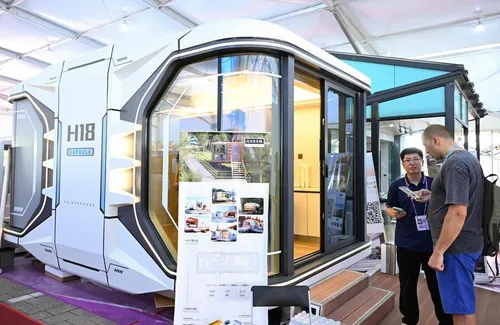
At Dongguan Port in China's Guangdong Province, gantry cranes load container-like building units onto ships destined for Australia, North America and the Middle East. Each unit is a compact, ready-to-assemble room. In Huiyang district of Huizhou, Guangdong Province, CSCEC Science and Industry, a subsidiary of Chinese construction giant CSCEC, runs a 400-meter, fully automated production line for steel-structure modular buildings.
The line can churn out 50 units per day, ten times the output of similar factories in North America, according to Li Huakun, chief engineer of a CSCEC subsidiary.
In Longgang district of Shenzhen, China State Construction Hailong Technology Company Limited operates a fully integrated module production line that yields a complete house every 20 minutes. Sand and concrete enter one side; a house emerges on the other. Robots can plaster 70 square meters of walls in 20 minutes, a task that typically consumes a human worker an entire day.
Every module bears a unique QR code, enabling full production data to be traced with a single scan. More than 70 percent of the construction process has moved to the factory, slashing project timelines by over 60 percent.
China's prefabricated housing sector focuses on steel and concrete structures. Steel is preferred for its lightweight nature and suitability for overseas shipping and high-rise buildings. Conversely, concrete aligns with traditional Chinese living preferences and enjoys greater domestic acceptance. In New South Wales, Australia, an apartment complex using Chinese-made modules requires less than half the labor needed under conventional methods, reducing construction time to a few months instead of about two and a half years for traditional construction.
Labor typically accounts for 30 to 40 percent of total construction costs under conventional methods; modular construction can lower overall costs by over 10 percent.
Overseas clients prioritize delivery quality, speed, and cost. Chinese construction firms are meeting these demands by leveraging robotics, digital factories, and eco-friendly materials. These companies are evolving into integrated solution providers, combining products, standards, and branding. Backed by the world's most comprehensive construction supply chain, Chinese firms can swiftly source every component in China, from steel and concrete to bathroom fixtures and appliances.
Modular construction promises a new productive force for the building industry, and Chinese firms are confident in their ability to make modular construction a driving force in global industrialization.
Written by urgent.news from IOL's reporting — not their text. Machine-written — may contain errors; check the original before relying on it.