Zap Rocks. Add Water. Get Clean Hydrogen
In a tranquil Boston suburb , on the far edge of a horse farm, where pasture gives way to woods, a crane lowers an enormous electrode into a borehole. The electrode, a half-meter-long cylinder with copper-tipped arms to ensure good contact with the borehole walls, descends—deeper, deeper—through layers of spongy sandstone to the hard, marbled roots of an ancient mountain range hundreds of meters…
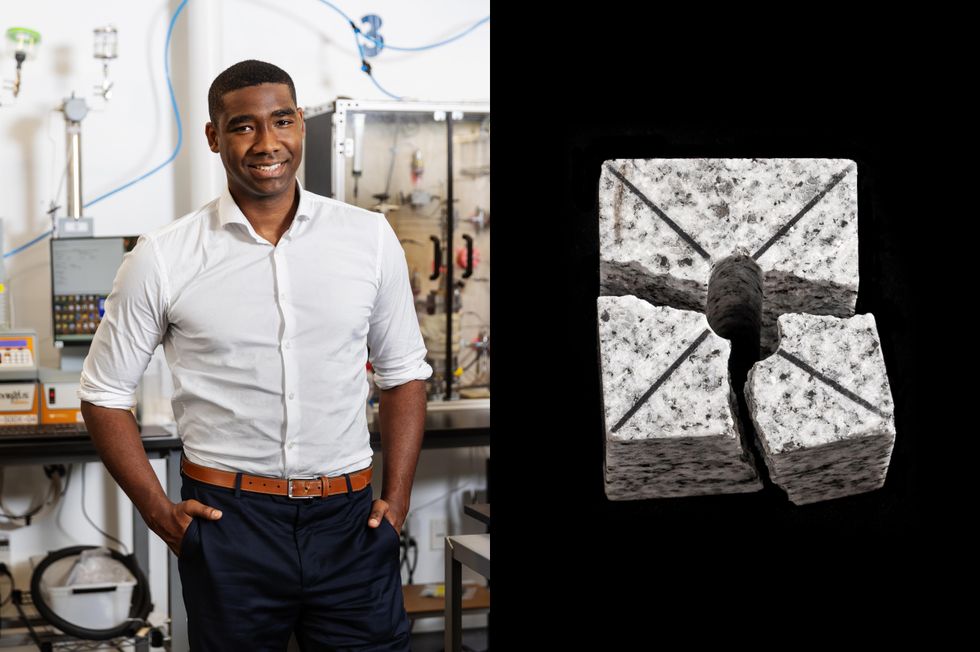
In a quiet Boston suburb, adjacent to a horse farm, a crane delicately lowers an electrode into a borehole. This electrode, measuring half a meter in length, is equipped with copper-tipped arms that ensure strong contact with the walls of the borehole. It descends deeper and deeper, penetrating layers of spongy sandstone until it reaches the solid, marble-like foundations of an ancient mountain range, hundreds of meters below the surface.
The rock here is tight, with few cracks permitting water or gases to flow. However, this is about to change.
Just a short distance away, a second electrode—identical to the first—has been securely positioned within another borehole at the same depth. From the ground above, high-voltage generators, linked to the two electrodes, emit a series of pulses. Each discharge, faintly audible at the surface, resembles a miniature, underground lightning bolt.
As the rock between the electrodes heats up, pressure builds. Suddenly, the rock fractures into a network of intricate patterns. On a horse farm outside of Boston, a worker oversees the installation of the well where Eden's electrode will be lowered using a winch. Eden GeoPower, a Massachusetts-based startup conducting this unique field test, refers to their technique as electrical reservoir stimulation. Their slogan: "We break rocks with electricity."
Eden's researchers envision their innovative rock-breaking method eventually contributing to mineral mining, harnessing geothermal heat, or creating geological reservoirs for carbon storage. However, there exists a more intriguing application that could revolutionize energy production: generating hydrogen underground. The concept of hydrogen-powered economy traces back to the 1970s.
Petroleum shortages and growing concerns about pollution from fossil fuels inspired visions of cars, ships, planes, and industrial machinery powered by hydrogen rather than carbon. Though hydrogen is often hailed as a clean fuel because its combustion or consumption in fuel cells produces only water and heat, current methods of producing it consume more energy than they generate.
Traditionally, the cheapest and most common approach involves reacting steam with methane, a potent greenhouse gas.
An alternative to manufacturing clean hydrogen involves locating it underground. Over the past five years, numerous companies worldwide have been searching for buried reserves of hydrogen, known as natural or geologic hydrogen. However, establishing a commercial-scale operation remains unproven. Eden and a few other startups and research groups are pursuing a more ambitious approach: producing geologic hydrogen artificially, referred to as stimulated geologic hydrogen or engineered hydrogen.
This process essentially transforms underground rock formations into massive hydrogen plants. It typically entails injecting water into iron-rich rock, which oxidizes the iron and yields hydrogen as a by-product. The fracturing of the rock, as Eden is doing, establishes a series of channels allowing water to reach iron-bearing minerals.
The notion of stimulated hydrogen is so novel that few have had the opportunity to test its efficacy. Proponents assert that if it proves successful—a significant "if"—it could theoretically provide an almost limitless energy source for an indefinite period. The only way to ascertain the truth is to commence breaking rocks.
Written by urgent.news from IEEE Spectrum's reporting — not their text. Machine-written — may contain errors; check the original before relying on it.