Scientists create largest 2D map of the universe with 5.6 trillion pixels and nearly 4 billion cosmic objects
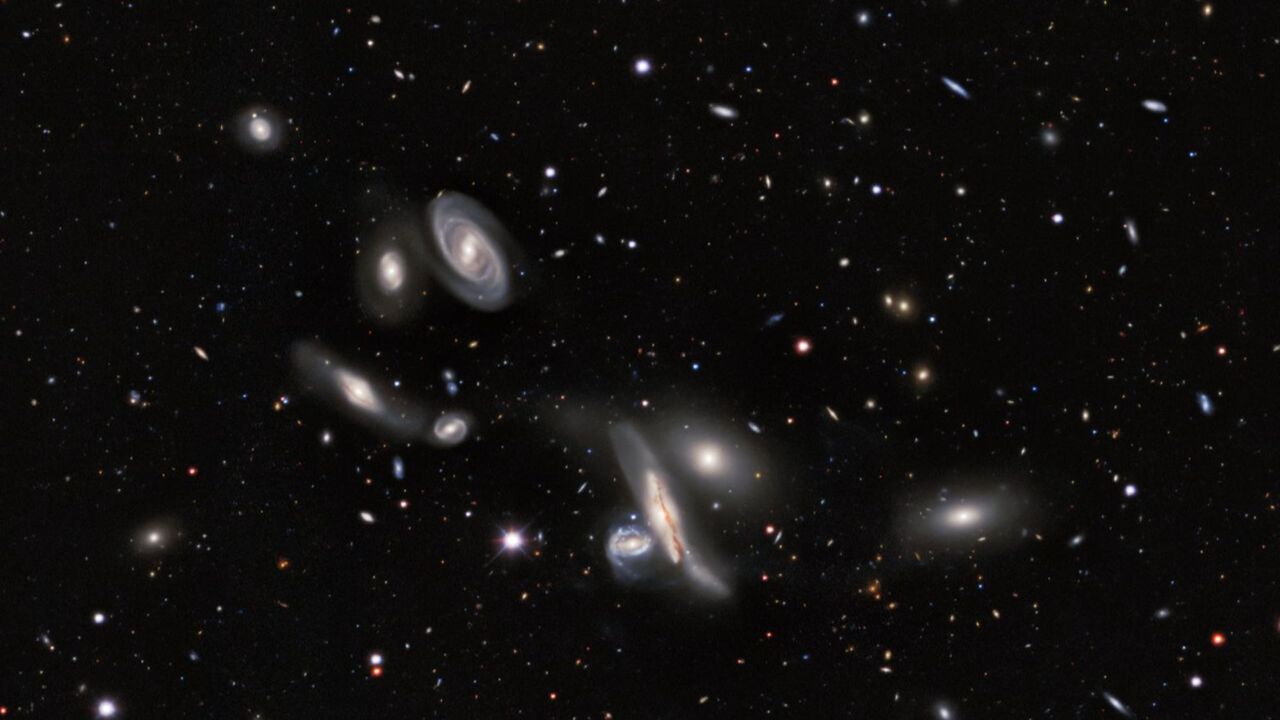
The Dark Energy Spectroscopic Instrument (DESI) Legacy Imaging Surveys team has unveiled the most extensive 2D map of the universe to date, featuring a vast collection of nearly 4 billion cosmic objects across roughly three-quarters of the sky. The map, comprised of 5.6 trillion pixels, is the result of over a decade of telescope observations, totaling more than 263,000 exposures.
Spanning visible and near-infrared wavelengths, this comprehensive portrait offers astronomers a detailed view of stars, galaxies, and other celestial phenomena scattered throughout the cosmos. David Schlegel, co-lead of the Legacy Surveys and a scientist at Lawrence Berkeley National Laboratory, emphasized the significance of the map, noting that it serves as the foundational tool for DESI's three-dimensional mapping efforts.
The Legacy Imaging Surveys were originally intended to assist DESI in pinpointing its thousands of robotic optical fibers, which ultimately paved the way for the project's broader mission to map the universe in three dimensions. Installed on the Mayall 4-meter Telescope at Kitt Peak National Observatory in Arizona, DESI utilizes spectroscopy to measure the redshifts of galaxies and quasars, enabling astronomers to calculate their distances and translate the flat sky map into a three-dimensional representation of the cosmos.
Launched in 2021, DESI's primary objective is to trace the expansion of the universe over billions of years, thus shedding light on the enigmatic dark energy believed to be driving this expansion. However, DESI has already exceeded its initial goals, mapping more than 47 million galaxies and quasars by April 2026, thereby creating the largest high-resolution 3D map of the universe thus far.
Among the nearly four billion objects included in the map is Messier 96 (NGC 3368), a stunning spiral galaxy located approximately 35 million light-years away in the constellation Leo. This extensive dataset, featuring over 1,800 references in scientific publications, holds immense value beyond DESI. It can aid in the discovery of rare cosmic objects and phenomena, facilitate the study of galaxy evolution, and facilitate the training of artificial intelligence systems for analyzing massive volumes of observational data anticipated from upcoming telescopes.
Written by urgent.news from Space.com's reporting — not their text. Machine-written — may contain errors; check the original before relying on it.
This story
This is one outlet's version. Read the fullest account.