Reforj developer 4J Studios unveils Rixels: modified pixels that reduce texture memory requirements by 98%
Reforj developer 4J Studios has debuted a technology called Rixels that offer an alternative way to provide textures using a fraction of the memory requirements. The Dundee-based studio has applied to patent the technology. Read more
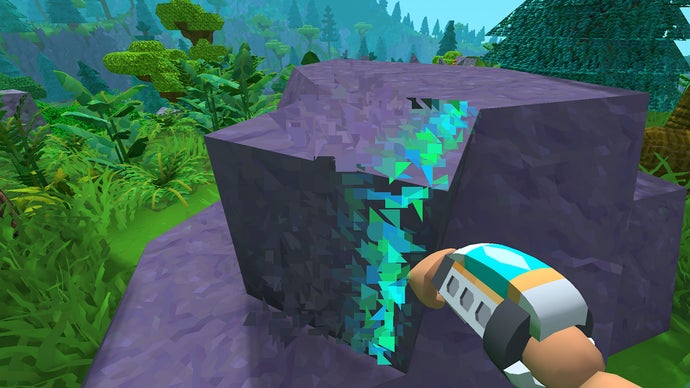
4J Studios, the developer behind Minecraft-like game Reforj, has introduced a new technology called Rixels, which provides textures using significantly less memory. The company, based in Dundee, has applied for a patent for the technology. Rixels, meaning Reforj Pixels, are modified pixels that incorporate vector shapes, allowing them to retain their sharpness even when viewed closely.
The innovation came about as a solution to the issue of texture size, explained 4J Studios chairman Chris van der Kuyl to GamesIndustry.biz. With 512x512 normal textures, the studio found themselves running out of space as game size increased. Van der Kuyl challenged the studio's Chief Technology Officer, Richard Reavy, to devise a solution, leading to the creation of Rixels.
Each Rixel contains one of 23 vector shapes, which are mathematical formulas used to create images that do not become pixelated regardless of the rendering size. By utilizing Rixels, a 512x512 pixel grid in Reforj, which previously required 4MB of memory, can now be made up of 20x20 squares using only 72KB of memory – achieving an impressive reduction of over 98% in memory requirements.
One of the key advantages of Rixels is that as players zoom in, the textures do not become fuzzy. Unlike many other games, which start to exhibit pixelation at certain points, Rixels maintain perfect resolution. The company has applied for a patent for Rixels, and van der Kuyl expressed surprise that the technology hasn't been used before. He finds the simplicity of the solution surprising, asking, “Surely somebody’s done this before.”
Rixels are integrated into 4J Studios' proprietary Elements Engine, which was developed to enable the studio to create their own sandbox games after years of porting Minecraft to consoles and handhelds. The memory saved by Rixels helps prevent performance dips in voxel-based games, allowing for a consistent frame rate of 60 frames per second.
Regarding potential licensing of the technology, van der Kuyl expressed interest in exploring its application in various mediums. While the technology was designed for gaming, he is open to the possibility of it being used in graphic design tools or other applications. However, he acknowledges that the technology may not be as beneficial for photorealistic games compared to stylized ones. Van der Kuyl remains optimistic about the potential uses of Rixels in other contexts.
Written by urgent.news from GamesIndustry's reporting — not their text. Machine-written — may contain errors; check the original before relying on it.