Optimized two-photon microscopy enables voltage imaging at multiple depths
The tool could reveal how information flows within and between cortical layers during neural processing.
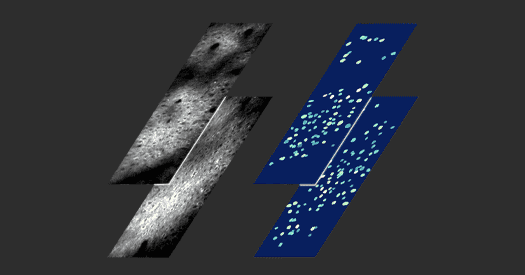
A groundbreaking optical imaging platform has been developed that enables researchers to scan neural activity across wider areas and deeper brain tissue simultaneously. This platform, called FlatMux, represents an optimized system for two-photon voltage imaging, offering significant improvements over previous methods.
Traditionally, calcium indicators have been used to measure neural activity, but these only provide a proxy for electrical activity and change more slowly, obscuring fine timing information. Genetically encoded voltage indicators (GEVIs) directly track neural activity but have limitations, such as being confined to small areas and producing weaker signals that last only around a millisecond.
Traditional two-photon microscopes, which are used to scan neural activity, have challenges in scanning speed and energy efficiency. To address these issues, FlatMux employs an innovative approach involving an array of mirrors that splits a laser beam into 14 "light beads," which are then scanned through the sample in parallel. This arrangement allows the measurement of many more points at once, improving energy efficiency and enabling the scanning of larger areas, up to 590 × 400 microns.
The platform also offers a deep mode, capable of recording from neurons 500 microns within the brain, and a rapid mode with frame rates of 2 kilohertz. Moreover, FlatMux demonstrates versatility by allowing the simultaneous imaging of two planes, which can be particularly useful for studying how information flows between different cortical layers during neural processing.
This platform has been demonstrated in mice while their whiskers were stimulated, providing insights into the sequential activation of neurons in different cortical layers. Such information could be crucial for understanding how neurons in different layers communicate and contribute to complex neural computations. Additionally, the platform's sensitivity allows for the detection of subthreshold activity, which can provide valuable information about the connectivity between neurons.
As voltage indicators continue to improve, FlatMux is designed to accommodate these advancements, further expanding its capabilities. However, the cost and complexity of the platform may present challenges for widespread adoption. Nevertheless, the potential applications of this technology in tracing the flow of information within and between cortical layers during various neural processes make FlatMux a significant advancement in the field of neuroscience.
Written by urgent.news from The Transmitter's reporting — not their text. Machine-written — may contain errors; check the original before relying on it.