On the hunt for dark matter
From Broadway to MIT’s Laboratory for Nuclear Science, PhD student Jessica Fry doesn’t do anything halfway. Now she’s hunting for the universe’s most elusive particle.
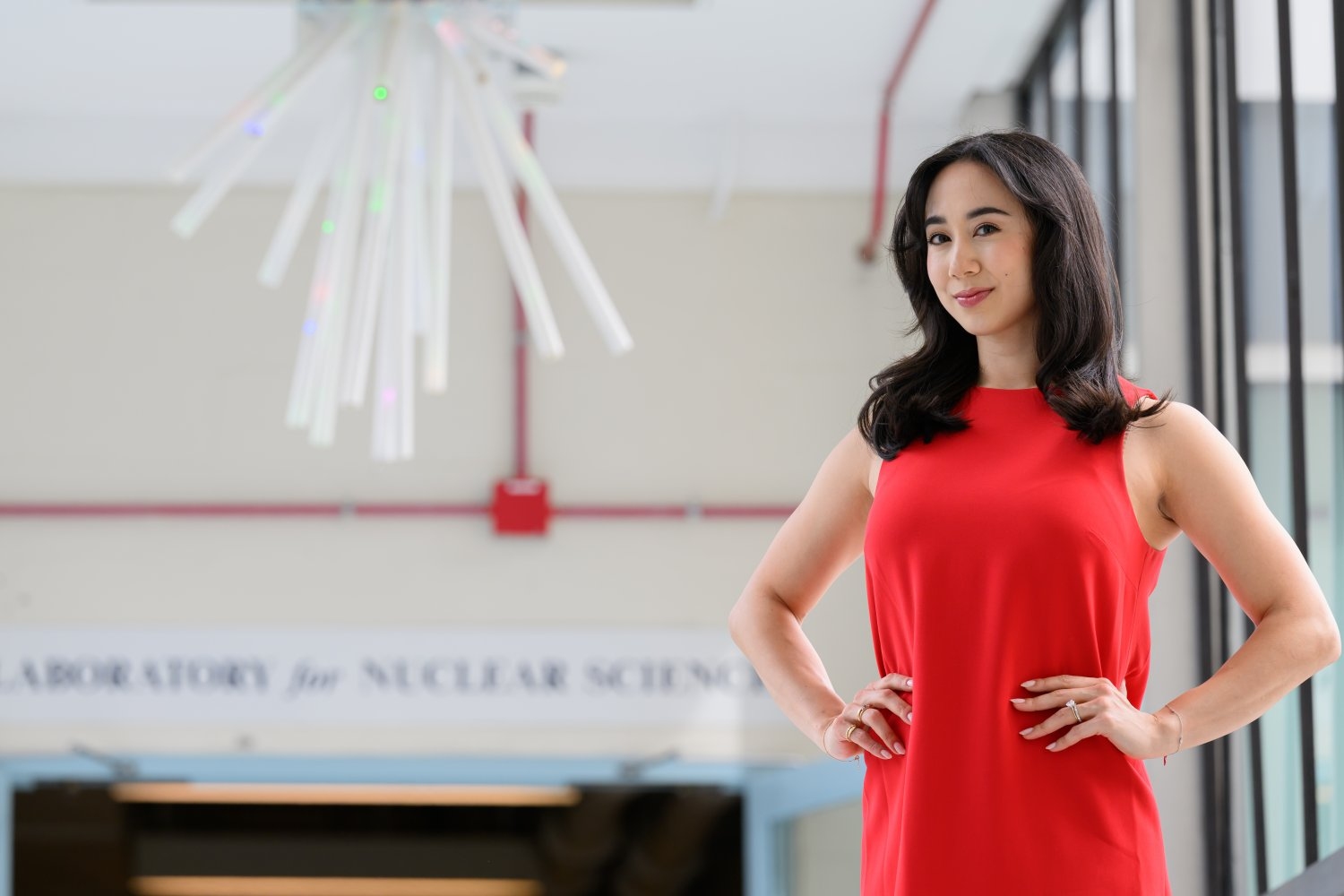
Physicists worldwide are actively searching for a mysterious particle responsible for nearly 85 percent of the universe's matter, yet no one has ever directly observed it. Jessica Fry, a fifth-year PhD candidate in the Laboratory for Nuclear Science (LNS) at Stanford University, is one such investigator. Raised in the San Francisco Bay Area, she began dancing at age three and later competed nationally in elementary school.
A photograph of her in a ham costume during a recital hangs on her office desk, reminding her that she doesn't "half-ass" anything.
Fry's passion for science ignited when her high school physics teacher gifted her a pair of outdated detectors from SLAC National Accelerator Laboratory. She studied a 1960s paper employing similar equipment, replicated the experiment, and wrote up the project, becoming hooked on the subject. Fry then pursued her undergraduate studies at Stanford, majoring in physics and theater and performance studies.
She complemented her academic pursuits with intensive dance training in ballet, contemporary, jazz, Māori, Peking opera, and stage combat.
However, Fry eventually grew weary of the constant external judgment and loss of self-confidence that came with her dance career. After a period of reflection, she returned to Stanford to finish her degrees. It was there that she learned about dark matter, the elusive substance that makes up nearly 85 percent of the universe's matter but has never been detected directly.
Fry is searching for the axion, a hypothetical particle believed to be the most promising theoretical candidate for dark matter. She is involved in two experiments: ABRACADABRA at MIT and DMRadio at Stanford. Both detectors rely on the principle that axions, if they exist, should produce a faint, oscillating electric current when exposed to a strong magnetic field.
Fry's work combines her scientific expertise with her passion for dance, as she strives to develop a distinctive and robust method for detecting this elusive particle.
Written by urgent.news from MIT News Research's reporting — not their text. Machine-written — may contain errors; check the original before relying on it.