Last-minute scramble for eclipse safety glasses
Glasses to watch the eclipse have become a rare commodity in Cornwall.
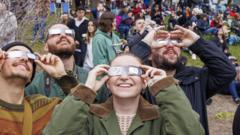
Specialist glasses for safely viewing a solar eclipse are in high demand, according to a Cornwall tourism expert. Peter Friend, a leader in the tourism industry in Looe, stated that his organization purchased 80 pairs of these glasses for visitors to the partial solar eclipse event scheduled for Wednesday evening, but they were all sold out within 10 minutes. Many businesses placed orders for these glasses, but they may not arrive in time.
An ophthalmologist has warned that directly viewing the sun during an eclipse can cause significant damage to retinas, the light-sensitive lining at the back of the eye. David Jones, a consultant ophthalmologist at Royal Cornwall Hospital, emphasized that the only safe way to view the eclipse is through certified eclipse glasses that comply with the ISO 12312-2 safety standard or by observing it indirectly.
He cautioned that looking directly at the sun during an eclipse can cause retinal burns due to the eye acting as a powerful magnifying glass.
Peter Smith, among the 70 people documented by the Royal College of Ophthalmologists who experienced eye damage during the 1999 eclipse, shared his lingering effects. Even years later, he still experiences occasional visual disturbances. In Devon and Cornwall, the eclipse is expected to begin at 18:18 BST, reach its peak at 19:15, and conclude around 20:10. Various associated events are being organized in both counties.
Carolyn Kennett, an astro-archaeologist from Penzance, Cornwall, studying how ancient cultures interacted with celestial events, highlighted the lack of historical safety information regarding eclipses in the past. She expressed optimism about clear skies in Cornwall and ventured to Spain to witness a full eclipse. Throughout history, Kennett pointed out, people have been both awed and terrified by eclipses, which would have left daytime skies suddenly dark to those without scientific knowledge of the phenomenon.
Written by urgent.news from BBC Science's reporting — not their text. Machine-written — may contain errors; check the original before relying on it.