Conflict with Saudi Arabia: Why the violence in Yemen is flaring up again
Since 2014, Yemen has been plunged into civil war. At the time, there was relative calm, but now violence is once again flaring up. Is further escalation in the context of the Iran war imminent?
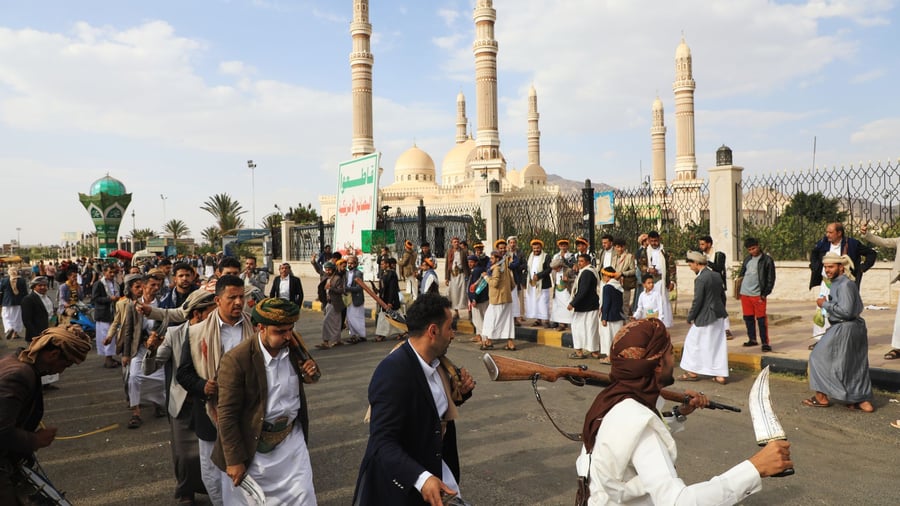
A fresh conflict is threatening to emerge in the Middle East, with renewed violence erupting in Yemen, a desperately poor country on the Arabian Peninsula. The Yemeni conflict has escalated once again amid the Iran war. Here are the details: Who is fighting whom in Yemen? The internationally recognized government in Yemen, alongside neighboring Saudi Arabia, has been at war with the Iran-backed Huthi militia for several years.
The Huthi, who seized Yemen in 2014, have controlled the north of the country and large parts of the western coastal Red Sea ever since. They violently impose their ideology, referred to officially as "Ansar Allah" ("Supporters of God"), on the territory. The attacks by the military coalition led by Riyadh aimed to support the Yemeni government and curb the influence of the Huthi and thus Iran in the country.
A ceasefire was declared in 2022, but smaller skirmishes continued. The recent attacks mark the most severe escalation in the Yemeni conflict in years. What triggered the current attacks? The escalation began in July with air strikes in Yemen's capital, Sanaa, controlled by the Huthi. According to the internationally recognized government's own statements, this was to prevent the landing of an Iranian aircraft on Yemeni soil.
The Riyadh-led coalition controls access to Yemeni airspace and significantly restricts international flights, particularly to Sanaa airport. The plan to allow an Iranian aircraft to land in the capital, the Huthi claim, aimed to challenge their control over the Yemeni airspace. Experts suggest that the Huthi have become stronger through the course of the Iran war, supported by Iran.
The Denkfabrik International Crisis Group observed a "turning point," as Tehran had previously advocated for a de-escalation of the situation in Yemen. The Huthi held Saudi Arabia responsible for the July attack on the Sanaa airport and declared a "sea blockade" against the influential Gulf state. The Iran-supported militia has since attacked several Saudi ships and targets in the Gulf state.
What was the situation before? The war in Yemen since 2014 has turned into a humanitarian catastrophe, with millions of people in dire need of aid. Despite the country's oil and gas resources, Yemen remains one of the poorest and most underdeveloped nations in the world. Moreover, the conflict flared up repeatedly in recent years.
Yemen has been divided into two since 1967, and extremism is rampant, with frequent attacks and kidnappings. The Huthi have been supported by Iran without which they could not have built up their weapons arsenal, including rockets with a range of up to 3,000 kilometers, smuggled in through the sea. An elite unit of the Iranian armed forces is also said to have trained Huthi fighters.
Iran, on the other hand, has denied providing financial or weapons support to the Huthi. Since the Hamas massacre in Israel on October 7, 2023, the Huthi have expressed solidarity with the terrorist organization and have since attacked Israel and commercial ships in the Red Sea. The militia has also portrayed itself as a victim of a conspiracy between Israel, the US, and Saudi Arabia.
Its primary source of income is the sale of smuggled oil products. A further escalation is likely, with far-reaching consequences beyond Yemen. Additional attacks on ships could once again affect the shipping through the Red Sea and the strategically important Bab al-Mandab strait, through which Asian goods pass on their way to Europe via the Suez Canal.
The Huthi's actions have already substantially hampered global trade with attacks in the Red Sea since 2023, in solidarity with Hamas in the Gaza Strip. A new war could also significantly delay the already challenging efforts towards a political solution in Yemen. The conflict risks once again becoming a major stage for regional confrontation between Iran and its adversaries.
Written by urgent.news from Handelsblatt's reporting — not their text. Machine-written — may contain errors; check the original before relying on it.
This story
This is one outlet's version. Read the fullest account.