Investment for seniors: I'm 70: Which products should I still invest in now?
As soon as no salary is paid and the investment horizon decreases, many seniors become cautious when it comes to investing money. Leaving the money on the checking account is still not a good idea.
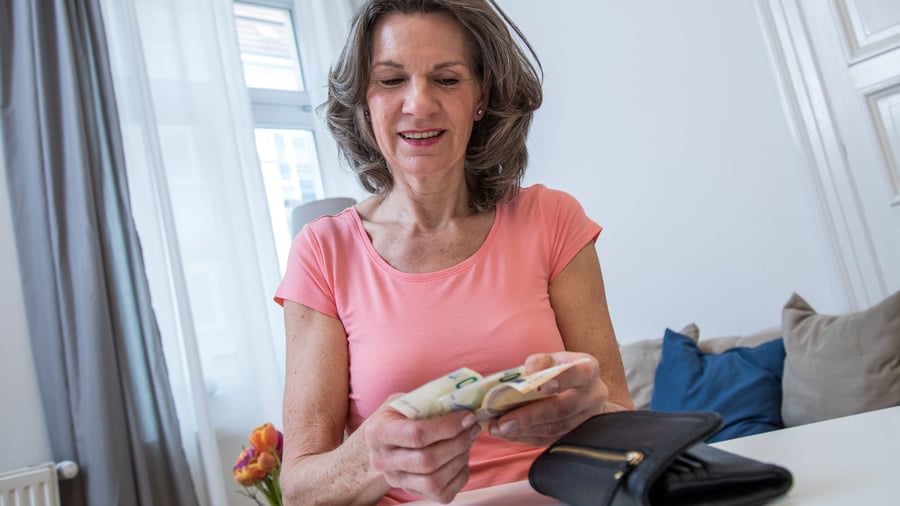
"The sooner, the better." When it comes to investing money, time is considered one of the most important factors due to the compound interest effect and the compensation of possible stock price fluctuations. But what if there's not much left of it due to an older age? "Then I still have different investment options," says Kevin Kronauer, a fee-based financial investment advisor. "But I have to look at the weighting and reduce risks."
The following questions and answers provide orientation on how to proceed. How do I find out if my money is invested correctly for retirement? "For this, I need to get an overview of what I have in the first place," says financial expert Niels Nauhauser from the Verbraucherzentrale Baden-Württemberg. In order to also reflect the various risks, he recommends assigning the asset portfolio roughly to four asset classes.
The first pile includes rather security-oriented investments with modest interest rates, such as call money, building savings, classic life and pension insurance, federal securities, bond ETFs, and pension funds. The second pile includes contracts that directly or indirectly invest in the stock market - such as individual stocks, equity funds, ETFs, and fund-based pension insurance. The third pile forms the real estate assets. In addition to the property, this also includes rented properties and real estate funds.
The fourth pile includes investments in commodities such as gold. "Now I also note down the annual costs of all products and the respective terms of contracts," says Niels Nauhauser. It would be good if the risks were spread across different asset classes, i.e., the four piles. From products that cause high costs and bring poor returns, it might be sensible to separate oneself promptly - or at the latest at the end of a possible term.
How much money do I need for what? Living expenses, planned trips, the upcoming senior-friendly renovation of the bathroom, a reserve for car repairs, health costs: "I need to make it clear to myself what expenses I expect for myself in the next five years," says Kevin Kronauer. This amount should be kept in the liquidity pot, as savers should have access to it at any time. Nevertheless, this amount should not simply be parked in the current account.
Because there are usually no or only insignificant interest rates there, even inflation cannot be compensated - the money becomes less and less valuable. "Here, we recommend a call or fixed-term savings account," says Markus Latta, financial expert from the Verbraucherservice Bayern. Comparisons always show that direct banks offer significantly better interest rates here than the local bank. Good overviews from serious providers can be found, for example, at the Stiftung Warentest.
"Anyone who does not trust themselves to open such an account online can perhaps ask in the family or with another trusted person," says Markus Latta. Kevin Kronauer also considers so-called money market ETFs to be a good option for investing the money from the liquidity pot. Money market ETFs are exchange-traded index funds that invest the assets of their investors in safe, short-term forms of investment such as bank deposits or government bonds with a short residual term.
"Here, I am neither dependent on the deposit insurance of the banks nor on the often fluctuating interest rates for call money," says Kronauer. Money market ETFs can be bought and sold daily - without fixed terms or notice periods. And what do I do with the money that I don't need for now? "In this case, one should consider whether one wants to pass on part of this money perhaps," says Markus Latta.
If this is the case, the investment horizon extends beyond one's own lifetime, which also makes investing in equity ETFs more attractive. "However, one should definitely have a conversation with the heirs beforehand and get an idea of the risks of value fluctuations," recommends Niels Nauhauser. Otherwise, it could happen that, for example, the children need the money directly after death, for example, to finance a property - and cannot ride out a possible bad stock market phase.
As another possibility, Markus Latta brings up a donation: "This way, I can pass on part of the money to the next generation and take advantage of the tax-free limits." The part of the assets that one invests for oneself should be moved to the so-called growth pot, as Kevin Kronauer calls it - our second pile. "A broadly based ETF portfolio is suitable here. Depending on my financial scope, I position myself more or less offensively here."
If the liquidity pot from the first pile is empty after five years, money is reallocated from the growth pot. "This is a very simple approach that still leaves me with investment options," Kronauer finds. In his consultations, Markus Latta often experiences that seniors have invested part of their money in funds managed by the bank. "Often these have a moderate development with rather high costs."
Then it might be advisable to switch this money to a suitable ETF. Niels Nauhauser also has retirees in his advisory service who want to learn more about ETFs. He shows them that the potentially higher returns always come with a rising risk. In the past, it has always been the case that broad equity investments have been nominally positive after a term of twelve years.
However, no one can predict whether one still has twelve years of life left and whether this rule of thumb will continue to prove itself in the future. Therefore, "there always remains a residual risk that I must be able and willing to bear," says Nauhauser. Are there investment products from which one should fundamentally distance oneself? "Basically, one should be wary of products that one does not understand," says Kevin Kronauer.
In addition, there are some dubious offers on the market that promise high returns with little risk. "These are often so-called grey market products that are not approved for sale to private investors," warns Niels Nauhauser. In such cases, there is often a lack of transparency about the investment strategy and risks. "In such cases, I would advise against investing," says Nauhauser.
Translated by urgent.news. Machine-written — may contain errors; check the original before relying on it.