Aquila the Eagle soars along the Milky Way
Aquila the Eagle is home to the bright star Altair, which forms one corner in the Summer Triangle. Look for it in the evening sky from July to November. The post Aquila the Eagle soars along the Milky Way first appeared on EarthSky .
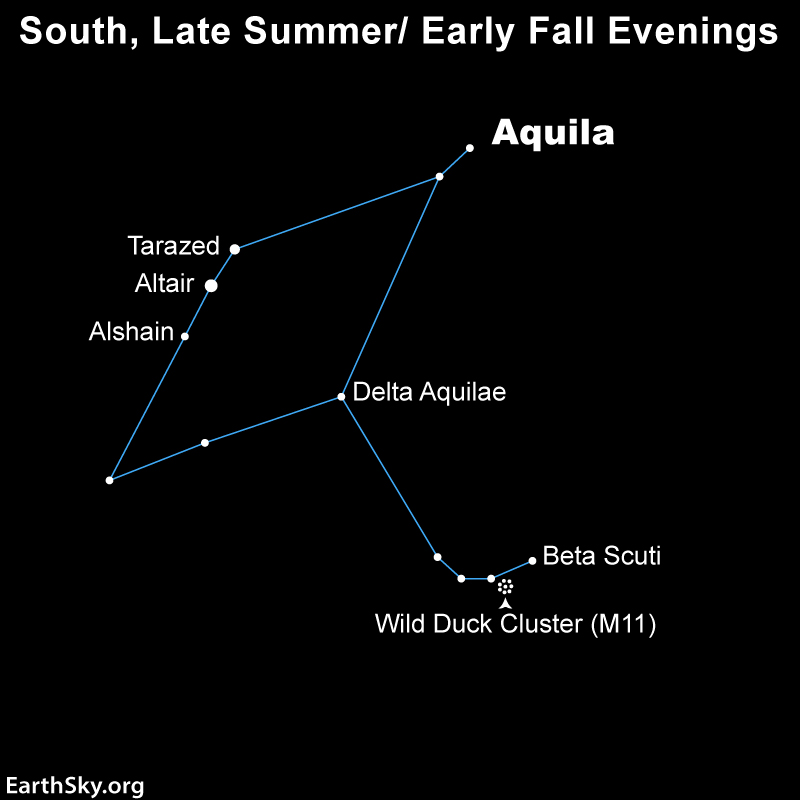
Aquila the Eagle is a constellation that is home to the bright star Altair, one of the vertices of the Summer Triangle. This constellation is best observed in the evening sky from July to November, as it traverses the Milky Way. The Northern Hemisphere's summer nights are the perfect time to spot Aquila soaring across the celestial sphere.
Altair, the brightest star in Aquila, has a magnitude of 0.76 and is located just 17 light-years away from Earth. It is one of three stars that form the Summer Triangle, with the others being Deneb and Vega. To the east of Altair, you can find Beta Aquilae (Alshain) and Gamma Aquilae (Tarazed), both of which have magnitudes of 3.71 and 2.72, respectively.
The stars marking Aquila's back and wings, Delta Aquilae and Theta Aquilae, respectively, are also notable. Delta Aquilae has a magnitude of 3.36 and lies 50 light-years away, while Theta Aquilae has a magnitude of 3.26 and is located 286 light-years away. The star at the end of Aquila's tail, Lambda Aquilae, has a magnitude of 3.43 and is 125 light-years away.
In addition to the stars, Aquila is also home to several clusters and nebulae. While there are no Messier objects in Aquila, there are two globular clusters, NGC 6749 and NGC 6760, situated near Delta Aquilae. NGC 6760 has a magnitude of 9.1, and NGC 6749 has a magnitude of 12. Furthermore, there are several open clusters in Aquila, such as NGC 6755 and NGC 6709, which are fainter but still visible with a telescope.
Written by urgent.news from EarthSky's reporting — not their text. Machine-written — may contain errors; check the original before relying on it.