World’s largest solar telescope reveals plasma vortices across the Sun
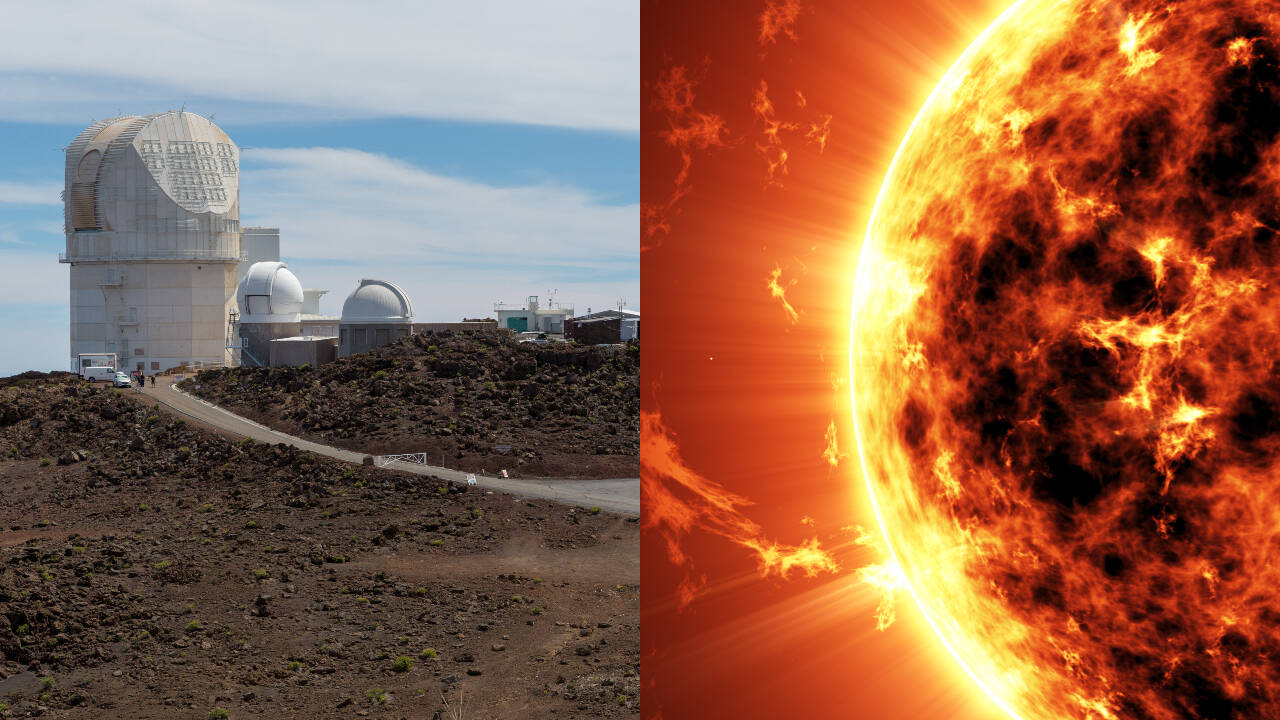
The world's largest solar telescope, the Daniel K. Inouye Solar Telescope (DKIST), has revealed intricate plasma vortices on the Sun's surface, offering scientists a unique view of previously hidden details. DKIST, a 4-meter class solar telescope operated by the US National Science Foundation, observed the Sun's photosphere, its visible surface, which is in constant motion due to convection.
This process involves hot plasma rising, cooling, and sinking, creating boiling-like patterns. Magnetic fields across the solar surface interact with this turbulent plasma, resulting in an ever-changing environment.
The high-resolution images captured by DKIST show that magnetic regions' edges are not smooth, but filled with miniature vortices and swirls. Researchers identified 47 vortices, which generally appeared around 65 kilometers apart and ranged in size from around 25 to 170 kilometers. These vortices moved across the Sun at speeds between 0.67 and 3 kilometers per second.
Scientists believe these small swirls are associated with the Kelvin-Helmholtz instability, a phenomenon that occurs when two layers of fluid or plasma move past each other at different speeds, producing a strong shear. This shear can make the boundary between the layers unstable, leading to waves and swirls.
The Kelvin-Helmholtz instability is caused by a velocity difference in the boundary between two layers of fluid or plasma, which can be seen in familiar examples such as wave patterns formed by wind blowing across water surfaces. Scientists predict that similar instabilities might occur on the Sun, but their small size made them difficult to observe directly. The new DKIST observations confirm these instabilities are common around magnetic regions on the solar surface.
The discovery, validated by computer simulations, indicates that the Sun's surface is far more dynamic and complex at small scales than previously thought. The vortices observed are created by the interaction between the Sun's convective flows and strong magnetic fields. Magnetic fields in the observed region are mainly vertical, while plasma flows are mainly horizontal, preventing the magnetic field from completely suppressing the instability.
The good agreement between observations and simulations strengthens researchers' confidence in the link between these swirling structures and Kelvin-Helmholtz instabilities.
Understanding these vortices and the Kelvin-Helmholtz instability could help scientists better comprehend how the Sun transports mass, energy, momentum, and magnetic fields through its atmosphere. This knowledge is crucial for understanding solar activity, as vortices can twist and braid magnetic field lines, affecting the storage and release of magnetic energy in the solar atmosphere.
This new perspective provided by DKIST offers scientists an unprecedented view of the Sun's turbulent processes, illuminating the dynamics that power its magnetic environment.
Written by urgent.news from Times of India's reporting — not their text. Machine-written — may contain errors; check the original before relying on it.