Why Standardized Developer Environments Still Break DevOps Workflows
Standardized developer environments promise to eliminate one of software engineering’s oldest explanations: “It works on my machine.” By packaging approved runtimes, dependencies and tools into containers, virtual machines or cloud workspaces, organizations expect every developer to start from the same foundation. The approach delivers clear benefits. It reduces onboarding time, minimizes…
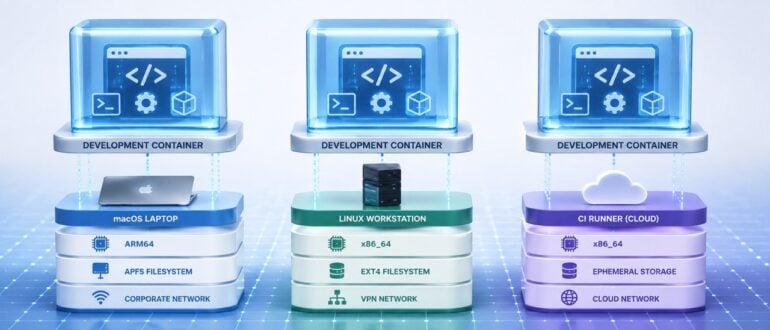
Standardized developer environments were intended to eliminate the perennial issue of "It works on my machine." By encapsulating approved runtimes, dependencies, and tools into containers, VMs, or cloud workspaces, organizations anticipated uniformity in the development experience. This approach had clear advantages. It cut onboarding time, reduced dependency conflicts, and simplified the process of reproducing development environments.
However, even when developers utilized the same environment definition, they could still encounter discrepancies in build times, test results, network behavior, or access issues. Results observed locally might also diverge from those generated by CI pipelines or in production, despite sharing the same container image. While a container defines a significant portion of the development environment, the surrounding systems continue to exert influence, complicating efforts to achieve full reproducibility.
The environment extends beyond the container. A development container encapsulates the operating system image, language runtime, command-line tools, editor extensions, and setup commands. The Development Container Specification offers a standardized method to describe these elements to enhance portability across supporting tools.
Yet, the container's behavior remains contingent on the host system. Factors such as processor architecture, memory, filesystem, virtualization layer, network configuration, security controls, and available peripherals can impact its functionality. GitHub Codespaces, for instance, executes development containers inside virtual machines and provides various machine types with different CPU, memory, and storage allocations.
The container definition may remain constant while underlying resources differ, as indicated in the GitHub Codespaces overview. Running a containerized environment locally introduces an additional layer of complexity. Docker Desktop operates its engine within a Linux virtual machine on macOS and Windows, necessitating network and file operations to traverse boundaries between the host, virtual machine, and container.
Docker's networking documentation elucidates these backend interactions. Standardizing what transpires inside the container enhances consistency, but it does not eradicate the influence of the underlying system. Integrations such as bind mounts, port forwarding, credential helpers, browsers, VPN clients, and local certificates link the standardized environment to the developer's machine.
These integrations are essential for daily operations, yet they also facilitate host-specific behavior to impact the development workflow. Filesystem behavior serves as a notable example. Linux filesystems are typically case-sensitive, whereas the default macOS filesystem is case-preserved but not case-sensitive. A repository containing both Config.js and config.js might function seamlessly on Linux but encounter conflicts when shared from a Mac.
Docker documents this behavior in its Desktop settings documentation. Similar challenges arise from file synchronization. Docker's synchronized file-sharing feature has documented limitations concerning file counts, symbolic links, and case conflicts. Consequently, extensive repositories may exhibit divergent behavior across host configurations, even when the development container itself remains unchanged.
Host-level issues can also disrupt development in ways that environment definitions cannot prevent. Memory pressure, storage problems, or virtualization failures can interrupt builds, irrespective of the shared environment configuration's stability. Acknowledging these dependencies is as crucial as standardizing the environment itself.
While containers bolster consistency, they do not supplant the operating system and hardware that sustain the development workflow. Standardization, rather than eradicating drift, can potentially exacerbate it. A shared environment definition remains valuable only when it is maintained. An image labeled "latest," an unpinned feature, or an installation script that downloads the newest package can yield a distinct environment with each rebuild.
Conversely, teams may postpone rebuilding shared images, fearing interruptions in development. Over time, these images persist with outdated packages, expired certificates, or obsolete tooling. Standardization consequently spreads the same outdated environment across the entire team. Persistent state compounds the issue, making it harder to detect.
Package caches, persistent volumes, editor extensions, and files generated by setup scripts often outlive their intended duration. Two workspaces constructed from the same configuration can gradually diverge due to one workspace amassing weeks' worth of state while the other starts afresh. This underscores why reproducibility necessitates more than a shared image.
The Reproducible Builds project identifies essential components of the build environment, including tools, versions, operating-system assumptions, and configurations. It also underscores how paths, locales, time zones, and other environmental disparities can affect build outputs. Mitigating drift necessitates proactive maintenance.
Essential dependencies should be pinned to immutable versions or digests, environments should be rebuilt on a defined schedule, and clean rebuilds should be tested regularly to confirm they yield the anticipated results. Local development and CI workflows are frequently standardized independently. Organizations may maintain separate configurations for developer workspaces and CI pipelines, each built from distinct definitions, maintained by different teams, and updated on separate schedules.
A developer may operate tests within a long-running container with cached dependencies and unrestricted network access. Conversely, the CI job executes on a newly provisioned runner with dissimilar preinstalled tools, limited credentials, and a pristine filesystem. GitHub acknowledges that each job on a GitHub-hosted runner initiates within a new virtual machine.
Written by urgent.news from DevOps.com's reporting — not their text. Machine-written — may contain errors; check the original before relying on it.