When and where to see the solar eclipse in London
What you need to know about the solar eclipse on 12 August and the best viewing spots in London.
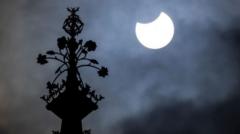
On Wednesday, 12 August, London residents will have the opportunity to observe a rare partial solar eclipse. A solar eclipse occurs when the Moon aligns between the Sun and Earth, casting a shadow on our planet and temporarily obscuring the Sun's light. During this event, approximately 90% of the Sun will be blocked by the Moon as seen from London, making it the most extensive coverage visible from the UK since 1999.
Key details about the eclipse include the temperature and light changes, though it will not result in a complete darkness. The first contact, when the Moon starts to cover the Sun's edge, is expected at 18:17 BST in London. The eclipse will peak around 19:12 BST and conclude at approximately 20:06 BST, as per Skyscanner.
Viewing a solar eclipse without proper precautions can harm one's eyesight. The UK Health Security Agency warns that the Sun may appear dimmer than usual, leading to potential retina damage. To safely view the eclipse, the Royal Museums Greenwich suggests using ISO 12312-2 certified eclipse glasses. Ordinary sunglasses are insufficient for protection against harmful solar radiation.
The museum also offers guidelines on creating a pinhole projector, which enables indirect viewing through a projection. A colander can serve as a makeshift projector by casting multiple images of the eclipse onto a surface.
For an unobstructed view of the eclipse, it is advisable to select an open space in the city, such as Greenwich Park. Tickets are available for a public partial solar eclipse viewing session near the Dolphin Sundial, hosted by the Flamsteed Astronomy Society, from 16:00 to 20:00. Other astronomical societies, including groups in Croydon, Warlingham, Addiscombe, Loughton, Chingford, Theydon Bois, and Tooting Bec, will also provide free viewing opportunities.
For those unable to attend in person, the Royal Observatory will offer a free live stream of the eclipse from London.
Written by urgent.news from BBC Science's reporting — not their text. Machine-written — may contain errors; check the original before relying on it.