Urgent.News

What's breaking now, across thousands of outlets.

Health & Medicine

We are chasing Ebola virus - it is ahead of us, WHO warns

Infection rates are high, adding to concern that authorities are struggling to get to grips with the disease.
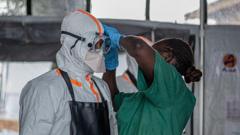
We are chasing Ebola virus - it is ahead of us, WHO warns

The Democratic Republic of Congo is currently experiencing a severe Ebola outbreak, with the World Health Organization (WHO) warning that authorities are still struggling to contain the virus. The outbreak began at least three months before it was officially declared on May 15th, resulting in over 1,900 deaths - making it the second-worst outbreak ever recorded. The Bundibugyo strain of Ebola is the primary culprit, centered in the eastern region of DR Congo where insecurity has complicated control efforts.

WHO Africa director Dr Mohamed Janabi cautioned that "we are chasing the virus, the virus is ahead of us" during a news conference in the outbreak's epicenter - the city of Bunia. This sentiment is backed by research indicating that the virus began spreading in February and was initially misdiagnosed as malaria or typhoid. Janabi cited the challenges posed by insecurity, stating that health workers are only reaching about 30% of the cases, with the remaining deaths occurring at home.

Cultural practices, such as traditional burial rituals where mourners touch the deceased's body, and a general mistrust of health authorities in certain communities, have also contributed to the difficulty in controlling the outbreak. However, there have been advancements in the situation, with several dedicated treatment centers now operational in the eastern part of DR Congo.

Diagnosis appears to be happening more quickly than before, with the country reporting 4,294 confirmed cases and 1,960 deaths so far. The most extensive Ebola outbreak on record took place in West Africa between 2014 and 2016, claiming 11,325 lives.

Written by urgent.news from BBC World's reporting — not their text. Machine-written — may contain errors; check the original before relying on it.

This story

This is one outlet's version. Read the fullest account.

Read the original at bbc.co.uk →

More in Health & Medicine

[Exclusive] Spent 2 hours in car searching for pharmacy…only 6 ‘public late-night pharmacies’ in Gangwon Province 심야에 갑자기 아프거나, 필요한 약이 있는데 집 근처에 마땅한 약국이 없는 경우. 많은 사람이 겪는 고충이다. 이런 불편을 해소하고자 정부는 2019년부터 공공심야약국을 운영하고 있다. When you suddenly feel unwell at night or need a certain medication but there isn't a suitable pharmacy near your home, many people face this problem. To alleviate this inconvenience, the government has been operating public late-night pharmacies since 2019. 하지만 강원도에 공공심야약국이 고작 6곳에 불과한 것으로 나타났다. However, it was found that there are only 6 public late-night pharmacies in Gangwon Province. 23일 더불어민주당 이수진 의원실이 보건복지부와 각 지방자치단체에서 제출받은 자료에 따르면, 강원도에 공공심야약국이 6곳 운영 중인 것으로 확인됐다. On the 23rd, Rep. Lee Su-jin of the Democratic Party of Korea's office received data from the Ministry of Health and Welfare and each local government, which confirmed that 6 public late-night pharmacies are operating in Gangwon Province. 광역 시·도 중에선 인천(18곳), 서울(18곳), 경기(17곳), 부산(13곳), 대구(12곳), 대전(11곳), 광주(10곳), 울산(8곳), 세종(6곳), 제주(6곳) 등은 공공심야약국이 6곳 이상 운영되고 있다. Among metropolitan cities and provinces, Incheon (18), Seoul (18), Gyeonggi (17), Busan (13), Daegu (12), Daejeon (11), Gwangju (10), Ulsan (8), Sejong (6), and Jeju (6) have more than 6 public late-night pharmacies operating. 그러나 강원도를 비롯해 충북(5곳), 전북(5곳), 전남(4곳), 경북(4곳), 경남(3곳), 충남(2곳), 충북(2곳), 강원(1곳), 제주(1곳) 등 9개 시·도는 5곳 이하의 공공심야약국만 운영 중이다. However, 9 provinces and cities, including Gangwon, Chungbuk (5), Jeonbuk (5), Jeonnam (4), Gyeongbuk (4), Gyeongnam (3), Chungnam (2), Jeju (1), and Gangwon (1) have fewer than 5 public late-night pharmacies operating. 특히 강원도는 도내 18개 시·군 중 12개 시·군에 공공심야약국이 단 한 곳도 없다. In particular, 12 out of 18 cities and counties in Gangwon Province have no public late-night pharmacies. 이 의원은 “공공심야약국이 시·도민의 건강을 책임지는 중요한 역할을 하고 있지만, 지역 간 편차가 크다”며 “국민의 건강권을 보장하기 위해 광역자치단체와 시·군·구 단위에서 적극적으로 공공심야약국을 확대해야 한다”고 말했다. Rep. Lee said, “Public late-night pharmacies play an important role in taking responsibility for the health of people in cities and provinces, but there is a large disparity between regions. To ensure people's right to health, public late-night pharmacies should be actively expanded at the level of metropolitan governments and cities, counties, and districts.”

More from Monday 10 August →