The Hiroshima Atomic Bombing Birthed a Strange, Never-Before-Seen Material, According to a New Study
The devastating blast vaporized buildings, metal, glass, soil and water. When the substances cooled and condensed, the process created spherical glassy grains—and some of them seem to contain a previously unknown metal alloy
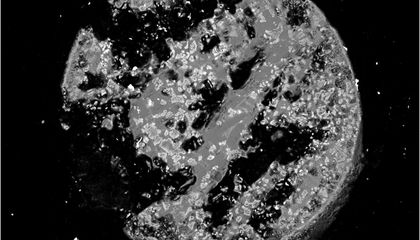
On August 6, 1945, an American atomic bomb devastated the Japanese city of Hiroshima, an event that would eventually lead to the conclusion of World War II. The devastation caused by the bomb was so profound that its consequences are still being discovered decades later. Recently, researchers have discovered a unique material dubbed "hiroshimaite," which was created under the extreme conditions of the bombing and has never been observed before. The findings of this discovery were published in the journal Science Advances on July 29.
Initially, scientists discovered minute glass particles on the shores of Hiroshima Bay, located on the southern part of Japan's main island. Upon closer examination, researchers identified these particles, known as hiroshimaite, as fallout debris from the atomic explosion. Recent studies reveal that these glassy spheres contain a previously unidentified metal alloy, made up of iron, chromium, nickel, manganese, molybdenum, silicon, and aluminum in an exclusive crystalline structure.
Luca Bindi, an Earth scientist at the University of Florence in Italy, explains that these minute particles still hold a detailed record of the explosion's conditions that existed for only a fraction of a second. He emphasizes that these grains are not just melted debris but rather physical archives of the explosion. Hiroshima's population at the time was approximately 350,000, with around 140,000 fatalities attributed to the blast by December 1945.
The atomic explosion generated a fireball hotter than 12,600 degrees Fahrenheit, causing buildings, metal, glass, soil, and water to vaporize into a turbulent plasma cloud. As this material condensed, it produced micrometer to millimeter-sized hiroshimaite grains. Scientists analyzed 34 of these particles using advanced microscopes and high-energy electron beams.
A particularly valuable technique utilized during this process was single-crystal X-ray diffraction, which reveals the three-dimensional structure of atoms and molecules in a material.
Interestingly, the alloy was found only in one of the analyzed glassy grains, suggesting its rarity. This discovery is not the first of its kind; Bindi previously led a team that found a novel silicon-rich glass with rare metal forms born from the world's first nuclear test, the Manhattan Project's Trinity test in New Mexico on July 16, 1945.
This material, called trinitite, along with the recently reported alloy, implies that extreme environments resulting from rapid quenching can systematically explore unusual regions of structural and chemical phase space.
These discoveries, including the new alloy, offer new avenues for research and deepen our understanding of how materials form and behave, according to Ángelo Oñate Soto, a materials scientist and engineer at the Universidad de Concepción in Chile. The Hiroshima alloy, a multicomponent alloy containing five or more metallic elements with significant fractions of each, is especially significant because it represents an unknown crystal structure within a widely used engineering material family.
Furthermore, this finding provides a framework for discovering and designing new alloys, highlighting the importance of studying blast-derived materials carefully and ethically.
Written by urgent.news from Smithsonian's reporting — not their text. Machine-written — may contain errors; check the original before relying on it.