Reimagining Life Beyond Parental Pressure And Societal Expectations
Recently, actor Aamir Khan shared that to his children—Junaid, Ira, and Azad—he is not a superstar but simply a parent who wants them to grow into confident, sensitive, and emotionally strong individuals. Rather than constantly pressuring them to become academic toppers, Aamir believes children should be encouraged to be happy, compassionate, and true to themselves. It is no surprise that his…
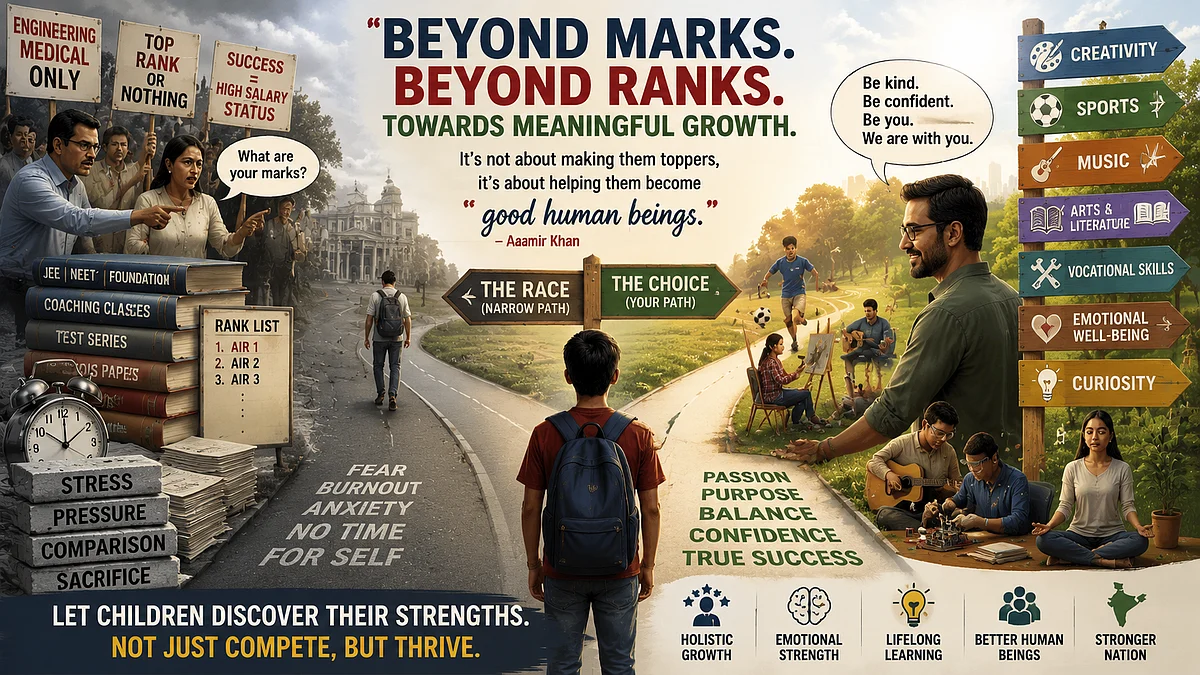
Aamir Khan, the renowned actor, recently expressed his desire for his children to grow up as confident, compassionate, and emotionally strong individuals. He discourages constant pressure to excel academically and instead encourages his children to be true to themselves. Many parents face similar challenges in raising children in a society that places immense emphasis on measurable achievement and success.
Children are often pushed into tuition classes from a very young age, leaving little room for other disciplines. By Class 10, the focus on engineering and medical entrance examinations intensifies, with students feeling immense pressure to succeed. The culture of overworking children has become disturbing, with teenagers juggling school and coaching classes, neglecting hobbies, sports, sleep, and emotional well-being.
This high-pressure environment has transformed adolescence into an age of turmoil. Indian society tends to equate intelligence primarily with science and mathematics, while those pursuing humanities, literature, fine arts, or vocational trades are often considered academically inferior. Parents are more proud when their children prepare for engineering entrance exams, while fewer boast about their children studying humanities or liberal arts.
This narrow definition of success, measured by grades, rankings, salaries, and social status, has led many young people to believe they must outperform others to succeed. Ayn Rand, a novelist, challenged this mindset, arguing that being obsessed with staying ahead of others rarely leads to creating anything original; instead, people become consumed by competition, hindering innovation.
India's competitive culture has its roots in the belief that education is the best way to escape poverty. Engineering and medicine have become symbols of stability and upward mobility, but years of hard work and impressive qualifications are now no assurance of a secure future, especially with the rise of AI transforming industries and IT sector layoffs.
The hierarchy of subjects reveals a flaw in the education system and social mindset. While science is important, why should it alone define brilliance? A student topping IAS, JEE, or NEET becomes front-page news, but a university topper in literature, philosophy, economics, or history hardly garners the same attention. Creativity, empathy, and imagination are essential to nation-building, yet our education system continues to prioritize rote learning over originality.
Students learn to echo textbook answers, shaped by an examination system that values predictability over innovation. Curiosity often becomes collateral damage in the pursuit of top grades. History shows that some of the greatest discoveries and artistic achievements emerged from curiosity, experimentation, and contemplation, not relentless cramming.
Isaac Newton's observation of an apple led to contemplation on gravity and motion, highlighting that moments of quiet reflection often spark transformative ideas. Many parents, driven by insecurity and social comparison, impose their unfulfilled ambitions on their children, like Neil Perry in Dead Poets Society. Young people often abandon their authentic aspirations under societal pressure, mistaking prestige for fulfillment.
Schools must foster analytical thinking, creativity, and emotional intelligence to allow intelligence to flourish in diverse ways. With a population of 1.4 billion, India cannot afford to define success through a single narrow path. Excellence should not be exclusive to science streams or examination toppers. True excellence lies in the honesty, skill, and passion with which one pursues their chosen path, regardless of societal labels.
Written by urgent.news from Free Press Journal's reporting — not their text. Machine-written — may contain errors; check the original before relying on it.