Off the Coast of Sicily, Divers Discovered a Roman-Era Shipwreck With Hundreds of Amphorae, Ancient Jars Frequently Used to Hold Wine
The site could offer fresh insights into Mediterranean trade routes more than 2,000 years ago
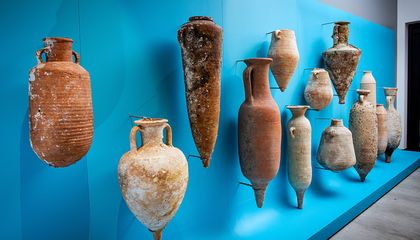
Giacomo De Mola, a fisherman and free-diver, discovered a Roman-era shipwreck teeming with amphorae off the coast of Sicily, as reported to the Canadian Broadcasting Corporation by Megan Williams. While exploring with friend Igor Bisulli, De Mola spotted the sonar picking up something unusual on the seafloor, which he initially thought was a large rock.
However, as he dove closer, he recognized the sonar had detected a pile of ceramic jugs with slender necks and handles. De Mola and Bisulli alerted Italian authorities, and the find has since been identified as a Roman-era shipwreck dating back to the first or second century B.C.E. The shipwreck, now submerged roughly 150 feet deep about three miles from the town of Mazara del Vallo, is covered with around 400 amphorae, primarily Dressel 1A type, believed to have transported wine.
The discovery, described by Italy's culture minister Alessandro Giuli as one of the most important underwater archaeological finds in recent years, sheds light on the Mediterranean's role as a crossroads of civilizations. Initial investigations were conducted by the Carabinieri in partnership with Sicily's Superintendency of the Sea, with experts planning to return to the site to determine the exact sinking date, origin of the cargo, destination of the ship, and assess the condition of the artifacts.
The site will remain undisturbed for the time being, but plans are in place to recover some artifacts for further study.
Written by urgent.news from Smithsonian's reporting — not their text. Machine-written — may contain errors; check the original before relying on it.
This story
This is one outlet's version. Read the fullest account.