Lion Nebula roars to life for Webb
Image: Observing across the starry “plains” of space, the NASA/ESA/CSA James Webb Space Telescope has taken images of NGC 2392, nicknamed the Lion Nebula. The NASA/ESA Hubble Space Telescope previously viewed this planetary nebula in 2000, imaging the lion face-shaped target in visible light and revealing features such as the “mane” of hazy, comet-shaped objects. Now Webb has captured a clearer,…
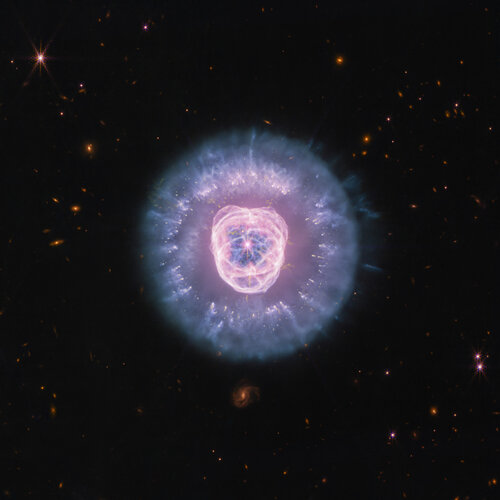
NASA's James Webb Space Telescope has unveiled a more detailed view of the Lion Nebula, also known as NGC 2392, in stunning infrared images. The nebula, resembling a lion's head, had previously been observed by the Hubble Space Telescope in visible light in 2000, revealing the lion face-shaped features. However, Webb's high-resolution imaging provides a clearer perspective of the nebula's intricate structures.
At first glance, Webb's images of the nebula may appear similar to Hubble's earlier view, but infrared vision highlights features such as compact clumps of dust and ionized gas. It took thousands of years for the gas and dust to reach their present shape, and the nebula's components continue to change. The central white dwarf star's energy is responsible for powering the complex structures seen within the nebula.
The nebula's "lion face" consists of a bubble of ionized gas that expands over time, destroying dust in its path. The mane of the lion is an interior dust shell illuminated by the white dwarf at the center, while the tufts of hair, resembling cometary tails, are compact dust clumps that protect the material behind them.
Webb's imagery captures the nebula in a single moment, though the star's death and its effects continue. Astronomers estimate that NGC 2392, the lion, will disperse entirely in about 10,000 years, a relatively short duration in astronomical terms.
Written by urgent.news from ESA Space Science's reporting — not their text. Machine-written — may contain errors; check the original before relying on it.