Interstellar Travel III: Antimatter to the Rescue?
With the end of the Space Age and the winding down of the Cold War, scientists again returned to the question of interstellar flight. Having failed to realize a working concept that could be realized in the near term, more exotic ideas began to be considered, reflecting further breakthroughs in theoretical physics.
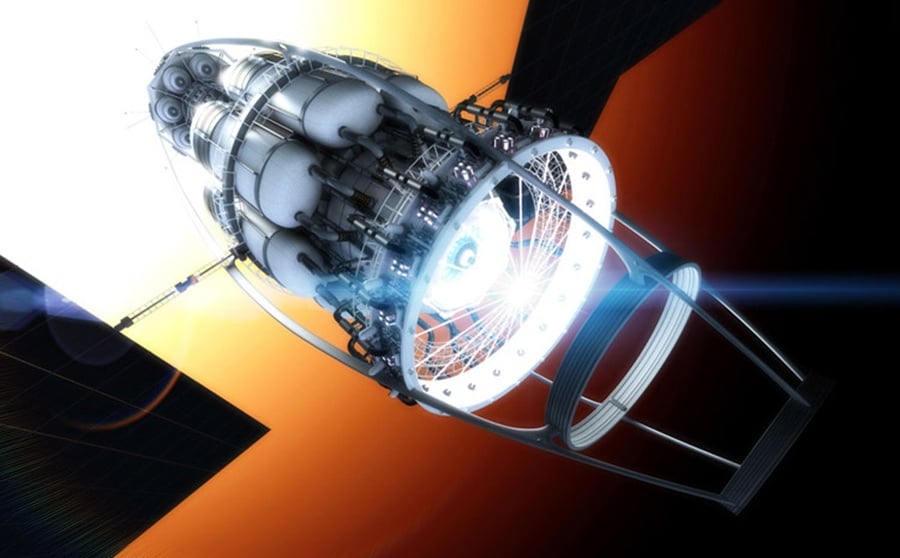
Welcome back to our series on Interstellar Travel, where we examine concepts proposed since the Space Age began. This installment explores the concept of antimatter propulsion. To recap, antimatter consists of particles having the same mass as ordinary matter but opposite charges and magnetic moments. When matter and antimatter collide, they annihilate, releasing vast amounts of energy – similar to a thermonuclear bomb.
The idea of antimatter propulsion emerged during the Cold War, alongside nuclear power concepts. In 1928, Paul A.M. Dirac proposed the existence of antimatter through his relativistic interpretation of Schrödinger's equation. Robert Oppenheimer further supported the theory in 1930, predicting the existence of positrons. Carl Anderson later observed positrons in 1932, and Emilio Segrè and Owen Chamberlain confirmed antiprotons in 1955.
Various proposals for antimatter propulsion have been put forth. Beam-Core Rockets use antimatter annihilation to produce charged pions or high-energy photons, which are then directed through magnetic nozzles to achieve relativistic speeds. Sänger Photon Rockets, proposed by German physicist Eugene Sänger in 1953, aimed to reflect gamma-rays from electron-positron annihilation. Robert Forward proposed proton-antiproton annihilation in 1985, estimating velocities up to 0.58 times the speed of light.
Thermal Rockets, another category, heat a conventional working fluid like hydrogen using antimatter annihilation. Friedwardt Winterberg's 2011 paper described generating a magnetic field that constricts rapidly, causing ambiplasma to collapse to ultrahigh densities for interplanetary missions. The next steps involve further research and development to make antimatter propulsion a reality for interstellar travel.
Written by urgent.news from Universe Today's reporting — not their text. Machine-written — may contain errors; check the original before relying on it.