Trade policy: China shock sparks economists' debate: How much does Peking cheat the West?
Economists as well as the US Treasury Department surprisingly defend China against accusations of manipulating its own currency in order to gain export advantages. What is behind this?
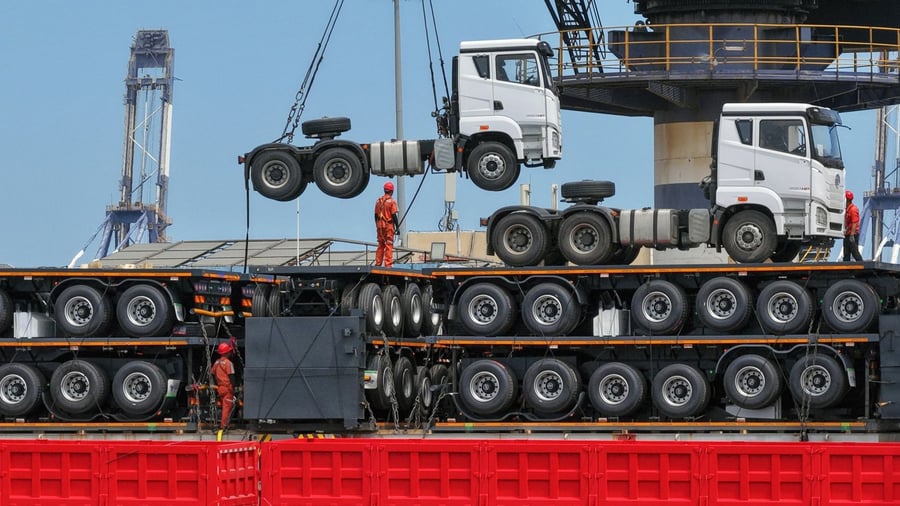
The export figures that Beijing announced on Friday once again exceeded all expectations. China's exports rose by almost 24 percent in July compared to the previous month. The numbers are confirming the critics of Beijing in the EU. For months, there has been talk of a "China shock 2.0" in Brussels, Paris, and Berlin. Beijing, the accusation goes, is using subsidies and the manipulation of its own currency to gain unfair export advantages.
The EU is therefore considering imposing comprehensive tariffs on Chinese imports for the first time.
With the blessing of the Federal Chancellor, who has recently also been criticizing Beijing's economic policy. According to analyses, hundreds of thousands of jobs in Germany alone were lost due to China's aggressive economic policy. But now, the "China shock 2.0" is getting a completely new dimension - and is becoming perhaps the currently biggest economic debate of our time.
Because China is getting unexpected support in its dispute with the EU - and that precisely from the USA, which under US President Donald Trump has unleashed a trade war with China. Germany "epicenter" of China shock 2.0.
Renowned US economists, including the chief economist of the International Monetary Fund (IMF), and the US Treasury Department say: The accusation that China manipulates its currency does not hold up. The undervaluation of the renminbi has natural causes.
What the economists who criticize Beijing's trade policy reject. The big question now is: Who is right? A lot depends on this - including how the German government and the EU behave towards China: Are they finally standing up to rightfully against Beijing's ruthless trade policy?
Or is the EU risking, without sufficient reason, unleashing a trade war with China, under which the German economy in particular would suffer? This is what it is all about. The first "China shock" is described as the situation after China's accession to the World Trade Organization in 2001, when the People's Republic became the "workshop of the world".
Mostly in the USA, many factories had to close at that time. Germany, on the other hand, benefited at the time because it could sell many machines to China. Since the beginning of the 2020s, a new China shock is taking place. And now Germany is no longer profiting, but is the "epicenter" of the "China shock 2.0", write economists Brad Setser and Sander Tordoir in an analysis.
China is now not only producing cheap products, but also high-tech products. This way, the People's Republic is penetrating domains of the German industry, taking market shares away from local car manufacturers, mechanical engineering companies, and chemical corporations. According to the employer-related Institute of the German Economy (IW), around 400,000 industrial jobs were lost in Germany between 2019 and 2025 alone due to China's trade policy.
"The bulk of deindustrialization in Germany can be attributed to China," says IW researcher Jürgen Matthes. There would be no reason for complaint if "made in China" products were simply better than those "made in Germany". But that is not the case, say not only Tordoir and Setser.
The rising export surpluses of China "are the result of a very deliberate strategy", says economic expert Gabriel Felbermayr. This includes a "strongly undervalued renminbi, capital controls, sectoral subsidies, artificially cheap credit rates, and cheap electricity".
With the export flood, China is trying to cushion the weak domestic demand. The state is helping the domestic economy considerably, according to the OECD. The organization of industrialized countries estimates that around 60 percent of the global market share gains of Chinese companies over the past 20 years are due to subsidies alone.
If a country exports as much as China, its own currency would tend to appreciate. But according to economists, it has not done so accordingly, but is undervalued by up to 30 percent because the Chinese state keeps the renminbi artificially low.
The competitive advantage of Chinese companies is therefore up to 30 percent, solely due to the undervaluation of the currency. "German companies have to deal with the price disadvantages caused by undervaluation every day when they encounter Chinese competitors worldwide," says economist Matthes.
Chancellor Merz also criticizes Beijing's currency policy, even if he does not mention China by name for diplomatic reasons. "I am not willing to accept that things can remain as they are currently, because this is a one-sided burden on jobs in Europe," the Chancellor said at the Franco-German ministerial council at the end of July.
But almost simultaneously, prominent economists questioned the thesis of the undervaluation of the yuan. In an essay in "The Economist", IMF chief economist Pierre-Olivier Gourinchas, former IMF chief economist Gita Gopinath, and French economist Hélène Rey argue that global trade imbalances are driven by domestic savings and consumption decisions in China - and not by an undervalued yuan.
"To make it clear: The Chinese yuan is undoubtedly undervalued," the three economists also write. But the exchange rate is "a symptom, not the cause" of structural problems in the Chinese economy. A country with weak domestic demand and a slump in real estate investments must inevitably have a weak currency, according to the three economists.
It is also correct that the Chinese currency is not allowed to fluctuate freely. However, China's currency interventions often served to prevent a depreciation of the currency, and the yuan was relatively stable. "The recent depreciation of China's real exchange rate is mainly due to the weaker inflation in China compared to its trading partners," the three economists write, i.e., an expression of the weak domestic demand.
Translated by urgent.news. Machine-written — may contain errors; check the original before relying on it.