Court proceedings: Russia election: opposition party fights against exclusion
With criticism of Russia's war against Ukraine, the liberal opposition party Yabloko wants to score points in the parliamentary election. Its Kremlin-loyal opponents want to prevent this before the Supreme Court.
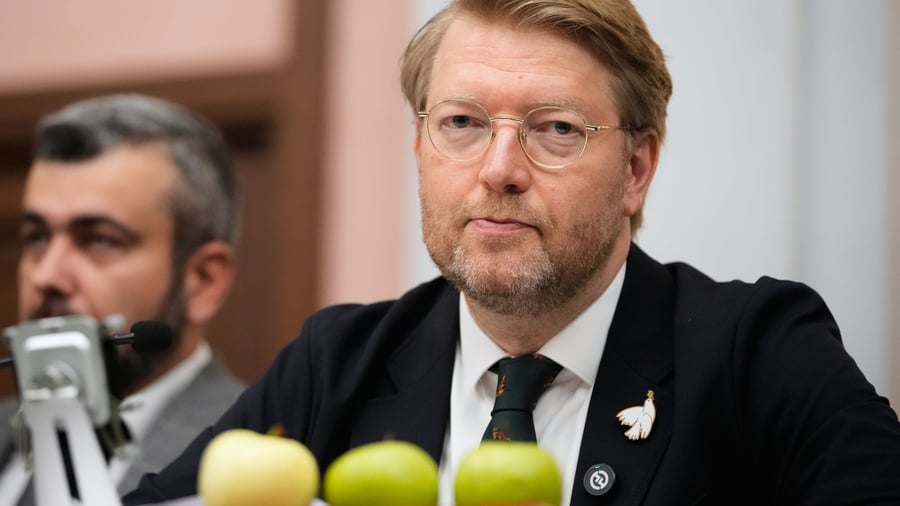
The liberal Russian opposition party Yabloko has defended itself before the Supreme Court in Moscow against its impending exclusion from the parliamentary election in September. Millions of Russians are ready to give their vote to his party, which criticizes the attack war against Ukraine, said Yabloko leader Nikolai Rybakov. "Political competition is the essence of elections," he emphasized.
The lawsuit filed by the pro-Kremlin party Rodina to exclude Yabloko from the Duma election aims to deprive people of a free choice. The trial, chaired by judge Vyacheslav Kirillov, is being broadcast live on the internet. It is unclear when a verdict will be delivered. In front of the courthouse in Moscow, hundreds of people were queuing up to get into the hall in the morning.
The party stated that it was only designed for 150 people and also published a video of the crowds. Rybakov spoke of a "historic trial" because no party that had been admitted to the election had ever been excluded later. The Central Election Commission had unanimously allowed Yabloko to participate in the election in July. The pro-Kremlin party Rodina accuses Yabloko of violating copyrights in its election campaign material, such as depictions of doves of peace, and of spending too much money on election advertising on the internet.
Yabloko lawyers contradicted the points in the 40-page complaint in hours of explanations. Yabloko: No evidence presented The party wants to participate in the election under the slogan "For Peace and Freedom" and promises a "life without fear" in view of the political repression in the country. Rybakov criticized that Rodina had not presented any evidence for the accusations, but was formulating inventions and absurd thoughts.
"The plaintiff confuses the courtroom with a talk show on television, where loud slogans, labels such as 'extremism' and subjective associations take the place of the law," Rybakov said of the allegations. Yabloko is an "exclusively peaceful, civilized, lawful political organization." A Rodina representative criticized in court that Yabloko's election program consisted of only 43 words and that the demand for a ceasefire in the war against Ukraine was in contradiction to the war goals.
Specifically, he mentioned the conquest of the Ukrainian regions of Donetsk, Luhansk, Zaporizhzhia, and Kherson, which the Kremlin had declared as war goals. Other pro-Kremlin parties had also called for Yabloko to be excluded from the vote in September. Several Duma deputies who support the Russian attack war against Ukraine insulted Yabloko members as traitors and agents of the West.
Criticism is particularly focused on the fact that not a single war participant is on Yabloko's electoral list. Yabloko recently recorded a noticeable influx of new members Observers explained the impending exclusion of Yabloko by the fact that the party had recorded a large influx of new members since its admission to the election - and that the risk of a possible success had become too great for the Kremlin.
Experts believed, based on surveys, that the party had a chance of crossing the 5% hurdle in the election and entering the Duma for the first time in more than 20 years. The nationwide parliamentary election and the local elections are scheduled for September 18-20. A total of 11 parties are allowed to participate in the Duma election.
So far, five forces are represented in parliament. Although the most prominent Yabloko members were not allowed to participate in the election because they were classified as "foreign agents," stood trial, or were in prison, even with the largely unknown names on the list, the approval ratings rose, according to political observers.
The political scientist Kirill Rogov believed that the Kremlin had initially allowed Yabloko's participation in order to siphon off votes from the Duma party Novye Lyudi (New People) and to pulverize the votes of the war opponents as a whole, if they were distributed among several parties. As the smallest of the five parties represented in the Duma, Novye Lyudi had recently increased in the polls after criticizing, among other things, internet blocking.
The ruling pro-Kremlin party United Russia, with its staunch war supporters, on the other hand, had declined. The pro-Kremlin party Rodina is considered an instrument of the power apparatus Rodina itself is a marginal party without political weight. Commentators believe that it serves the power apparatus and the pro-Kremlin parties as a willing instrument.
In court, quotes were given from interviews by party founder Grigori Yavlinsky, who repeatedly criticized the war. Yabloko rejected this - and emphasized that Yavlinsky was not running. Judge Kirillov is criticized by the Russian opposition as a vicarious executor of the Kremlin. He had recently also banned the human rights organization Memorial, which was awarded the Nobel Peace Prize.
Translated by urgent.news. Machine-written — may contain errors; check the original before relying on it.