Eyes on the sky: a rare solar eclipse will be visible from CERN on 12 August
Find out how to watch the 2026 eclipse safely
On 12 August 2026, CERN's staff and visitors will have the chance to witness a rare celestial phenomenon - a deep partial solar eclipse that will cover about 93% of the Sun's surface as viewed from Geneva. This event, one of many spectacular astronomical displays visible from the region in recent years, will begin at around 19:26 CEST and reach its peak at 20:20 CEST, shortly before sunset.
While the majority of the Sun will be obscured by the Moon, it remains crucial to remember that direct viewing of the eclipse without proper eye protection is extremely dangerous. The retina has no pain receptors, so injury can occur without any immediate warning signs. Even if large portions of the Sun are covered, the remaining light can still cause severe damage to the eyes.
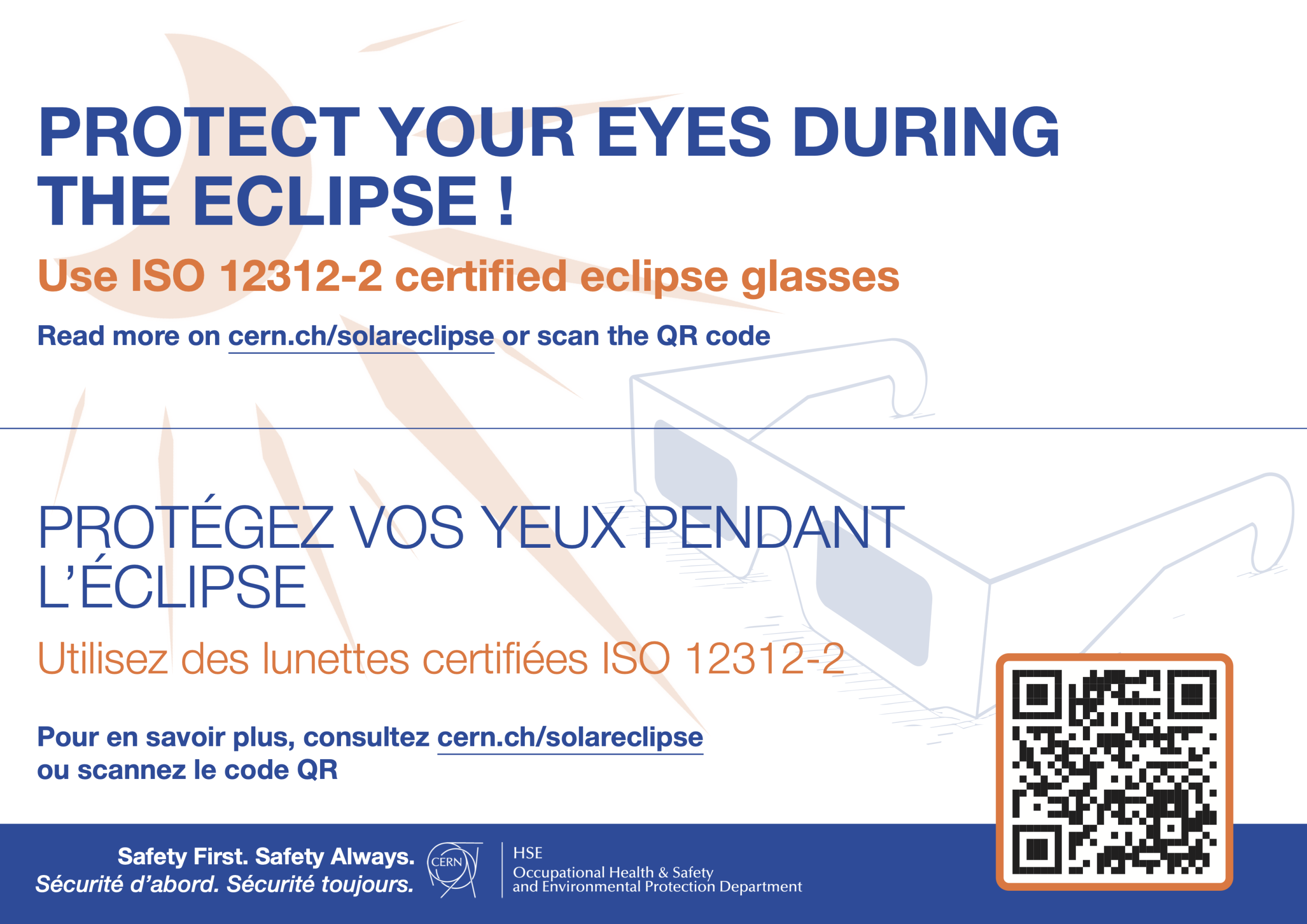
CERN participants are advised to use eclipse glasses that meet the ISO 12312-2 safety standard for viewing the eclipse. Ordinary sunglasses, smoked glass, and homemade filters are not sufficient for protection. Binoculars, telescopes, or cameras should never be used to view the eclipse without a solar filter in front of the optics.
If eclipse glasses are not accessible, indirect viewing methods such as a pinhole projector can be employed to safely observe the eclipse. Children must always be supervised during the event. Should anyone experience blurred vision, dark spots, or any change in central vision after viewing the eclipse, medical attention should be sought without delay.
CERN community members are encouraged to consult the Swiss Federal Office of Public Health’s guidance page for additional eclipse safety recommendations. By taking the necessary precautions, everyone can safely enjoy this exceptional astronomical event and set an example for others to follow.
Written by urgent.news from CERN's reporting — not their text. Machine-written — may contain errors; check the original before relying on it.