El Niño Alters Marine Life in the Pacific
Satellite measurements of chlorophyll at the sea surface signal shifts in the ocean’s nutrient supplies in mid-2026.
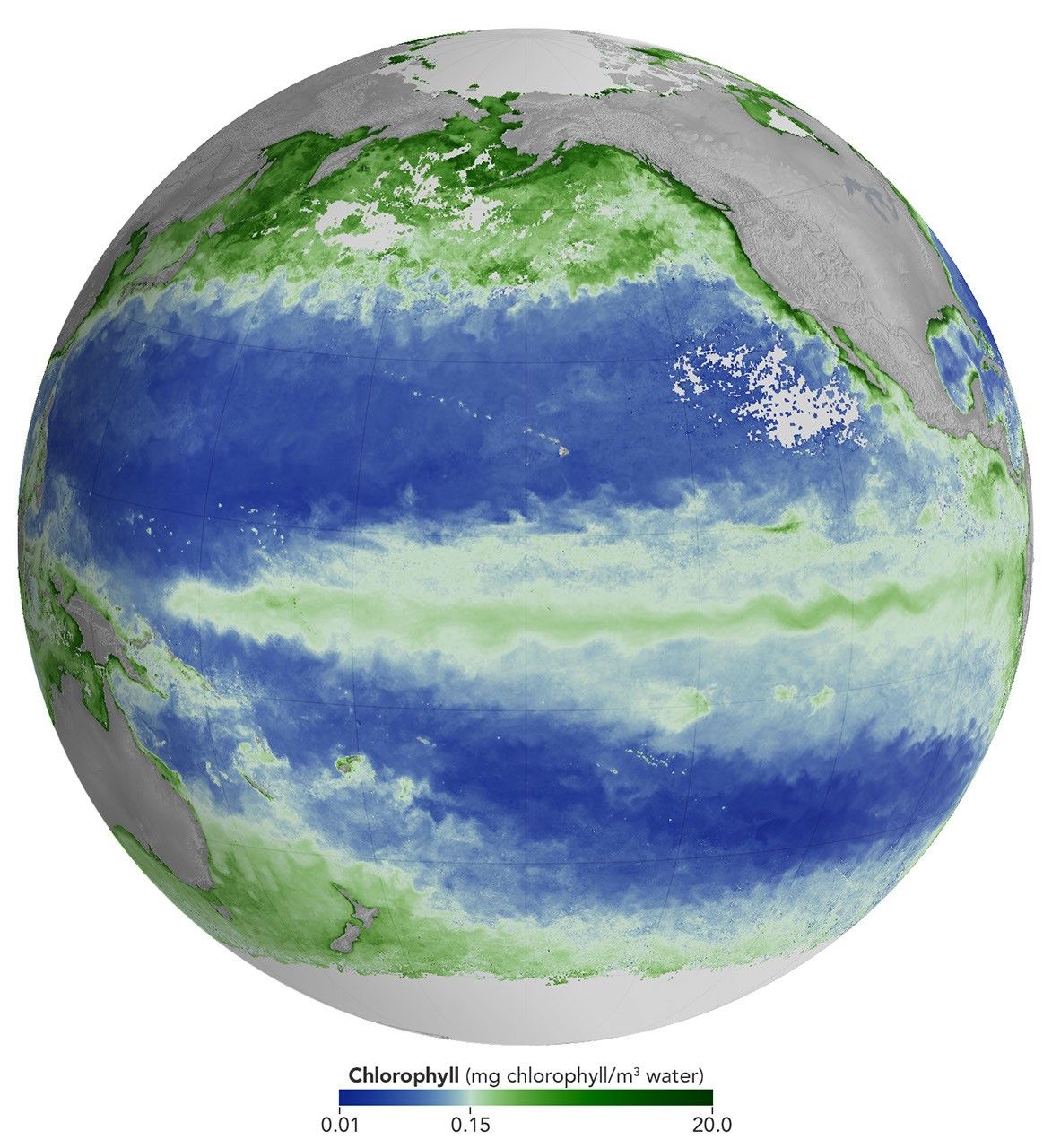
As of June 2026, the El Niño phenomenon has officially arrived, characterized by warmer-than-normal water temperatures and altered atmospheric and oceanic circulation patterns in the equatorial Pacific. This natural event can lead to a range of regional impacts, such as desert floods, delayed monsoons, and shifts in tropical cyclone formation. The NOAA Climate Prediction Center predicts that this El Niño will continue to strengthen through the end of 2026, with a 97% chance of persisting into early spring 2027.
Even during the early stages of El Niño, satellites have detected notable changes along the equatorial Pacific, including warmer sea surface temperatures and higher sea surface heights. One of the initial ecological consequences of this warming is a shift in the marine food web. In the central Pacific, around the equator, chlorophyll-a concentrations, which indicate phytoplankton abundance, have been notably lower in June 2026 compared to June 2025.
This reduction is attributed to the weakening of equatorial trade winds during El Niño, which suppresses the upwelling of cool, nutrient-rich water that typically supports phytoplankton growth.
The consequences of lower phytoplankton abundance ripple through the marine food web, affecting various species, including zooplankton, fish, seabirds, and marine mammals. For instance, Peru's anchovy fisheries have experienced significant declines during past El Niño events due to similar factors. In 2026, Peru's Ministry of Production has had to repeatedly suspend the fishery to protect the country's primary fishing resource.
In addition to these marine effects, the disruptions can force wildlife like pelicans to seek food in urban areas, such as Peruvian ports.
However, a rebound in chlorophyll concentrations post-El Niño is a possibility. Research suggests that higher iron concentrations from ocean currents and dust arriving from drier land in Central and South America can fuel this resurgence. While this rebound does not necessarily require a subsequent La Niña event, it has been observed in the past, such as during the 1998–1999 La Niña, which led to a large phytoplankton bloom in the eastern Pacific and increased fish populations.
The launch of the PACE mission in February 2024 has provided scientists with new tools to study these El Niño-induced changes. This mission offers global, near-daily hyperspectral measurements, enabling more comprehensive observations of the 2026 El Niño event. Researchers are particularly interested in using PACE data to understand the responses of specific phytoplankton communities to this event.
Beyond the marine realm, PACE's sensors can also measure plant pigment composition on land and cloud/aerosol dynamics in the atmosphere, all of which are influenced by El Niño. These insights will help scientists better understand the broader impacts of this climate phenomenon.
Written by urgent.news from Phys.org's reporting — not their text. Machine-written — may contain errors; check the original before relying on it.
This story
This is one outlet's version. Read the fullest account.
- El Niño alters marine life in the Pacific phys.org
- El Niño Alters Marine Life in the Pacific science.nasa.gov