Americans are as unhappy as ever. Could ‘a happiness-segregated society by marriage’ be why?
Americans went through a "happiness crash" right after the pandemic. The ones who are married are the only ones who really recovered.
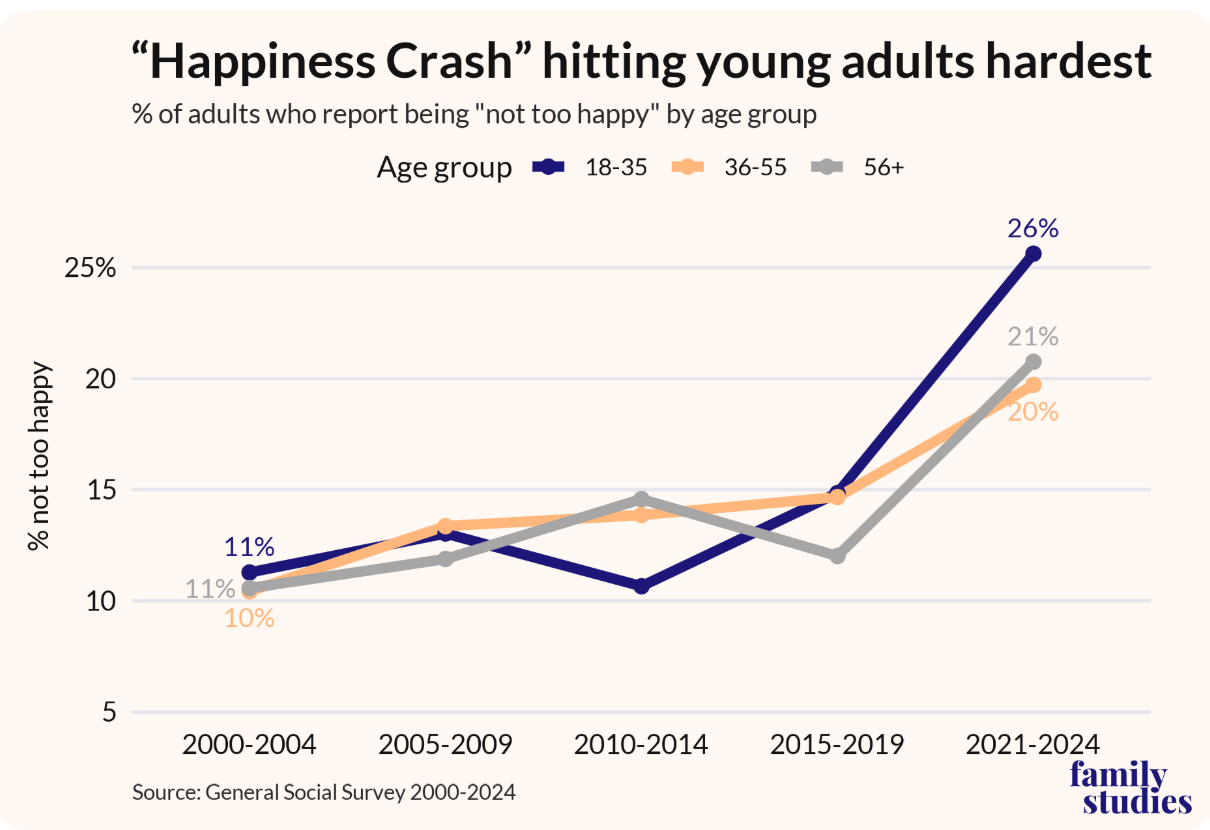
For over four decades, the General Social Survey has consistently measured Americans' happiness levels, with the percentage of "very happy" individuals consistently balanced by the percentage of "not too happy" individuals. However, the pandemic of 2020 caused a significant shift in this balance, with the happiness index plummeting by an unprecedented 25 points, followed by only a marginal rebound of 5 points.
This drastic decline is unlike any other economic shock, such as the Great Recession, which only caused a maximum 10-point drop and quickly recovered.
Economist Sam Peltzman of the University of Chicago's Booth School of Business has been tracking this data and suggests that the primary reason behind this unhappiness is not economic hardship, but rather the stark contrast between married and unmarried individuals. Peltzman's data reveals that the unhappiest Americans, those who saw the most significant drop in happiness, were not the lower-income individuals who would typically be affected by affordability issues.
Instead, it was the high-income, white, college-educated, and right-leaning individuals who experienced the most profound decline in happiness.
Peltzman's analysis indicates that married people are, on average, still happy, while unmarried people are now, on average, unhappy. The only group showing a clear positive balance in happiness is married individuals. The marriage rate itself has remained stable over the past 15 years, so the unhappiness is not solely attributed to the declining marriage rate.
The split between married and unmarried adults has remained the same even before and after the pandemic, but the magnitude of unhappiness has increased among the unmarried.
While both married and unmarried groups experienced a happiness decline, unmarried individuals seem to have been hit harder than their married counterparts. Married respondents went from a happiness score of +30 to +50, while unmarried respondents dropped from near break-even to about -15. This suggests that the unhappiness felt by unmarried individuals is more significant than the unhappiness experienced by married individuals.
Peltzman's research also indicates that other factors, such as economic pessimism, social media negativity bias, and declining social connections, may contribute to the increased unhappiness among the unmarried. Younger adults, particularly those aged 18 to 35, have shown a more pronounced decrease in happiness compared to other age groups.
The overall unhappiness across all age groups has remained relatively stable, ranging between 10% to 15%, but the proportion of unhappy young adults has significantly increased from 20% in 2021 to 26% in 2024. This decline in happiness seems to be closely linked to feelings of unfair treatment by others, which has also experienced a significant drop.
Written by urgent.news from Fortune's reporting — not their text. Machine-written — may contain errors; check the original before relying on it.