Eclipse on August 12: Wow Effect from Space - Why Heavenly Phenomena Fascinate So Much
People who experience a total solar eclipse still describe it as noticeably impressive even after many years. Why does this phenomenon fascinate us so much?
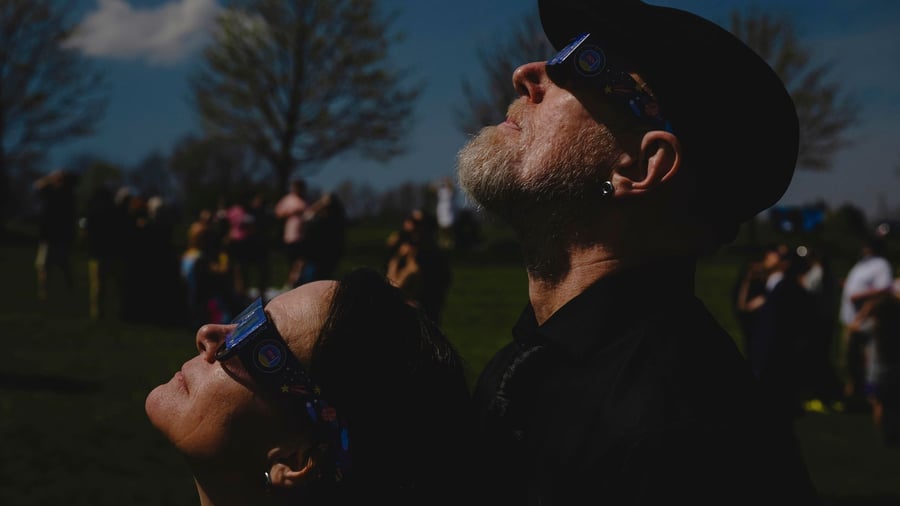
You can't see it when the moon approaches the sun. Suddenly, there is a small notch at the edge of the sun that gradually expands - and then it's gone, the donor of almost all life. Millions of people will look up at the sky when the sun is completely covered by the moon for a short, intense moment on August 12. "It's a small apocalypse that's scary," says psychologist Peter Walschburger from Berlin.
"We know it will come back, and we can enjoy the spectacle without real danger." A total solar eclipse is no longer a mystery, but can be predicted exactly for centuries in advance. For only a few seconds or minutes, it really gets dark. The celestial phenomenon is not particularly rare either: almost every year, there are at least partial eclipses somewhere on Earth.
Do you remember? Often the memory of a solar eclipse is vivid. And yet, a solar eclipse is one of those celestial events that fascinate people the most - especially if it's a total one. "Even today, it's a profound experience that you remember for a lifetime," says Guido Thimm from the Center for Astronomy at Heidelberg University (ZAH).
And even today, there is still a feeling of relief when the sun reappears. "During an eclipse, you can directly feel how important the sun is." The light changes abruptly during an eclipse, shadows change, the surroundings take on a silvery-gray tone, and the temperature can drop noticeably. Stars can become visible, and birds fall silent.
It's no wonder that a solar eclipse used to cause fear and terror. Before the triumph of natural sciences, it was considered an omen of doom for most peoples of the world, as Walschburger says. All possible plagues were attributed to it: wars, uprisings, epidemics, famines, earthquakes. What happened in the sky determined well-being and disaster.
Generally, unusual celestial events received a lot of attention - for good reason: the observation of the sky was used to predict the coming weather, and the position of the sun and star patterns was used to determine the season, as Walschburger explains. The stars served for orientation, and the moon phases for timekeeping. "Overall, people were much more dependent on nature and the celestial cycle."
Astronomy is the oldest science in the world, says Thimm. "Being knowledgeable about astronomy could decide between life and death." For example, court astronomers in ancient Egypt predicted the Nile floods important for agriculture as early as 5,000 years ago. The sky, seat of almost all gods. Additionally, the sky was considered the seat of divine powers with human characteristics in many cultures, explains Walschburger - unusual events like a sudden darkening were therefore inevitably perceived as socially significant.
Often, the sun played a central role, was revered as a deity, and source of life. In Egyptian mythology, for example, it was personified by the god Ra. This immense importance for everyday life and faith is still within us and is part of the fascination with solar eclipses and celestial events in general, Walschburger believes. "Cultural and civilizational development proceeds much faster than our natural genetic evolution."
Even though we are now much more independent of nature and can explain its phenomena scientifically, sensory perceptions like a dark cloud wall or a lovely sunny day are still closely linked to our psyche and well-being. With the ability to see, the desire to see decreases. Especially with the night sky, however, a man-made problem stands in the way of perception: light pollution.
Aside from solar eclipses and aurorae, interest in the starry sky is decreasing, says Thimm. "Simply because it's hardly visible in many places." You can only appreciate what you experience yourself. "Many children grow up almost completely without looking at the starry sky." One of the last places with a breathtaking starry sky is the Atacama Desert in northern Chile.
It's absolutely fascinating to look at the clear sky with zero light pollution. "You can read a newspaper by starlight," Thimm says. "You see the Milky Way rising, drawing an arc across the night sky, and setting again - that gives you goosebumps." The eye follows the metal chunks in space - and not the stars. However, even there, there's a problem: the growing number of satellites.
Already, it's harder to focus on the stars. "The eye is trained to move and follows the rapidly moving satellites." The interference from satellites is also terrible for science because it hinders astronomical recordings. "The result is a massive amount of disturbed or destroyed information," says Thimm. "It's really dramatic." In the coming years, the number of satellites is expected to increase rapidly. The unobstructed view of the night sky, as our ancestors had it, is definitely over.
Translated by urgent.news. Machine-written — may contain errors; check the original before relying on it.