NASA's MAVEN Illuminates New Understanding of Auroras at Mars
NASA MAVEN (Mars Atmosphere and Volatile Evolution) mission scientists have uncovered a key puzzle piece in understanding certain types of auroras on Mars, finding that they form in a similar way to Earth-based auroras.
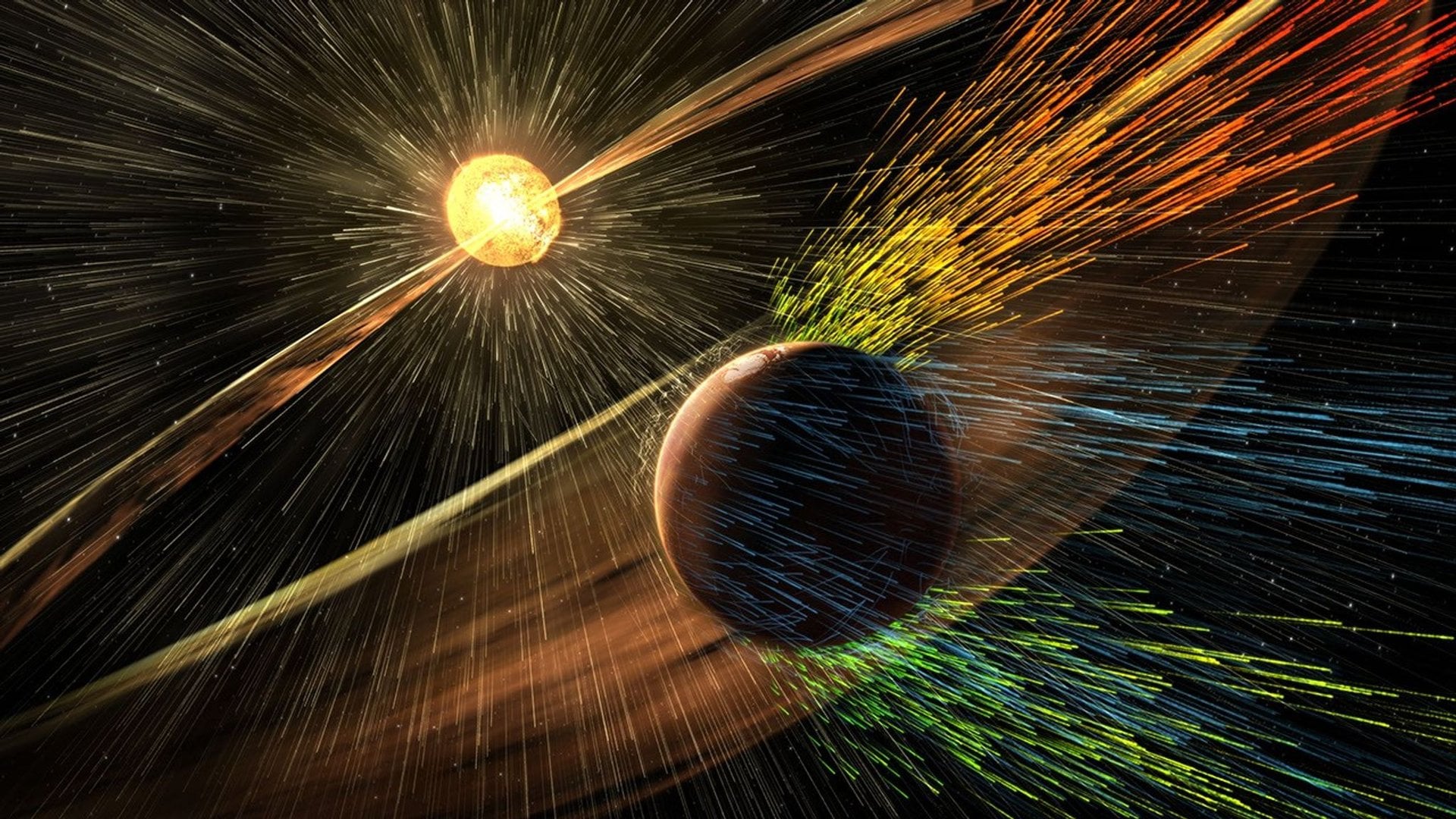
NASA's MAVEN mission, which studied Mars' atmosphere for over a decade before losing contact in December 2025, has revealed new insights into Martian aurorae. A recent study led by researchers from the University of California, Berkeley, found that Mars' aurorae form through a process similar to Earth's, despite the Red Planet's lack of a global magnetic field.
The research, published in Nature Communications, demonstrates that the same Dungey Cycle mechanism that circles charged solar particles around Earth's magnetosphere also occurs on Mars. However, Martian aurorae are much smaller in scale due to the absence of a protective magnetic field. The Dungey Cycle, named after British space scientist James Dungey, describes the process that drives electrical currents in Earth's magnetic field, accelerates charged solar particles, and controls plasma circulation in Earth's magnetosphere and upper atmosphere.
Mars lacks a planet-wide magnetic field, only having miniature magnetospheres created by magnetized crust scattered across its surface. The MAVEN mission, which gathered data using instruments like the Magnetometer, Solar Wind Electron Analyzer (SWEA), and Suprathermal and Thermal Ion Composition (STATIC) instrument, helped uncover the physics behind Martian aurora formation.
The study's lead author, Shaosui Xu, explained that while magnetic reconnection was known to occur on Mars, the team was surprised to find it functioning similarly to the Dungey cycle. This discovery not only sheds light on the process behind localized Martian aurorae but also aids in understanding how space weather interacts with the planet, which is crucial for future missions.
MAVEN's principal investigator, Shannon Curry, emphasized the significance of this finding, stating that it changes our understanding of Martian auroras and provides clues about the Red Planet's evolution.
Written by urgent.news from Universe Today's reporting — not their text. Machine-written — may contain errors; check the original before relying on it.