What can we see during the partial solar eclipse?
Ways to safely enjoy the partial solar eclipse on Wednesday evening.
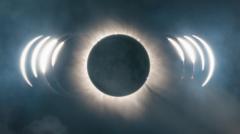
A partial solar eclipse is set to occur over the South West and Channel Islands on Wednesday evening, lasting approximately one hour and 50 minutes from 18:20 BST to 20:10. The event requires the sun, moon, and earth to be perfectly aligned, resulting in the moon casting two types of shadows. The main spectacle of this year's partial solar eclipse will be visible across an arc stretching from northern Russia to Greenland, Iceland, Spain, and northern Portugal.
Although the UK will not lie within the "arc of totality," observers will still be able to witness over 90% of the sun being covered by the moon.
Dr. Jean Dean, a Fellow of the Royal Astronomical Society based in Guernsey, explained that the eclipse progresses through several stages. First contact marks the moment when the moon's edge touches the sun's edge, after which the moon appears to bite into the sun. As the maximum occurs, observers might notice a slight change in temperature, followed by a darkening of the sky. Certain plants, known as nyctinastic plants, such as clovers, dandelions, and daises, will close their leaves during this period.
Plymouth Astronomical Society Chairman, Chris Cooke, described the darkness brought by the eclipse as "eerie," emphasizing that it will be the darkest partial solar eclipse since 1999. He added that the event is particularly notable as it is the closest partial eclipse to a total solar eclipse in recent years. As for safety concerns, the UK Health Security Agency (UKHSA) has warned the public to avoid looking directly at the sun without appropriate protection.
The agency recommends the use of eclipse glasses, handheld solar viewers, or alternatives such as pinhole viewers or projecting the sun's image onto paper.
Written by urgent.news from BBC Science's reporting — not their text. Machine-written — may contain errors; check the original before relying on it.