Reprogrammable MEMS-based fabry–perot pixel photomask
Scientific Reports, Published online: 08 August 2026; doi:10.1038/s41598-026-65843-4 Reprogrammable MEMS-based fabry–perot pixel photomask
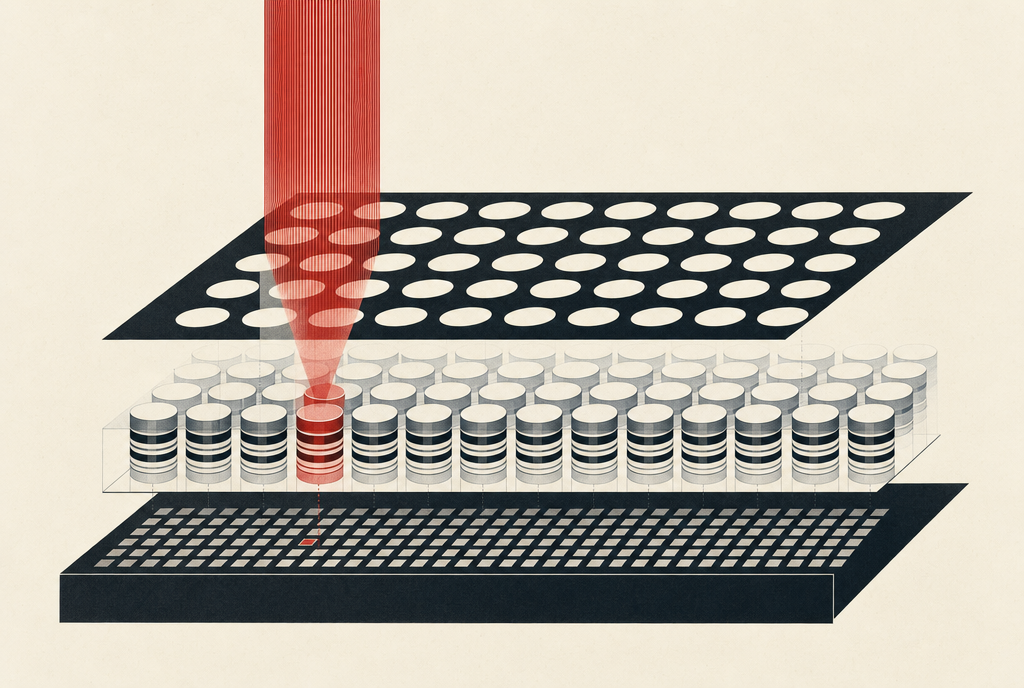
A groundbreaking reprogrammable photomask has been unveiled, leveraging microelectromechanical systems (MEMS) and the Fabry–Perot interference principle for optical patterning. This innovative approach enables adaptive lithography compatible with traditional stepper systems, offering a pathway for next-generation semiconductor design.
The novel device integrates a 10 × 10 MEMS Fabry–Perot pixel array onto a reticle-format module, accompanied by on-board PCB control, wireless programming, and photodiode-based synchronization to the stepper's exposure shots. The photolithography process was executed on a positive-tone photoresist using matrix-addressed pixels, updating predefined programmed states between exposures.
Systematic dose testing and dose-resolved analysis allowed the establishment of the process margin, revealing clear distinctions between resist development states due to Fabry–Perot modulation. With a pixel aperture of approximately 2.7 μm, lateral dimensions of resist features were successfully printed down to ~ 1.7 μm. This achievement marks a significant milestone, demonstrating the potential for pixelated lithographic dose modulation through projection by stepper optics.
The work establishes a practical foundation for reprogrammable photomask technology, compatible with industrial semiconductor equipment, and has the potential to accelerate the development cycle of new microelectronic circuits. This paradigm shift opens the door to individually tailored dies in semiconductor design. The research was supported by Institut Interdisciplinaire d’Innovation Technologique (3IT), Laboratoire Nanotechnologies et Nanosystèmes (LN2), Digitho Technologies Inc., and Mitacs, with partial support from the Cornell NanoScale Facility.
Written by urgent.news from Scientific Reports's reporting — not their text. Machine-written — may contain errors; check the original before relying on it.