Real-time target tracking in passive wireless sensor networks using sensor fusion and Kalman filtering
Scientific Reports, Published online: 08 August 2026; doi:10.1038/s41598-026-64980-0 Real-time target tracking in passive wireless sensor networks using sensor fusion and Kalman filtering
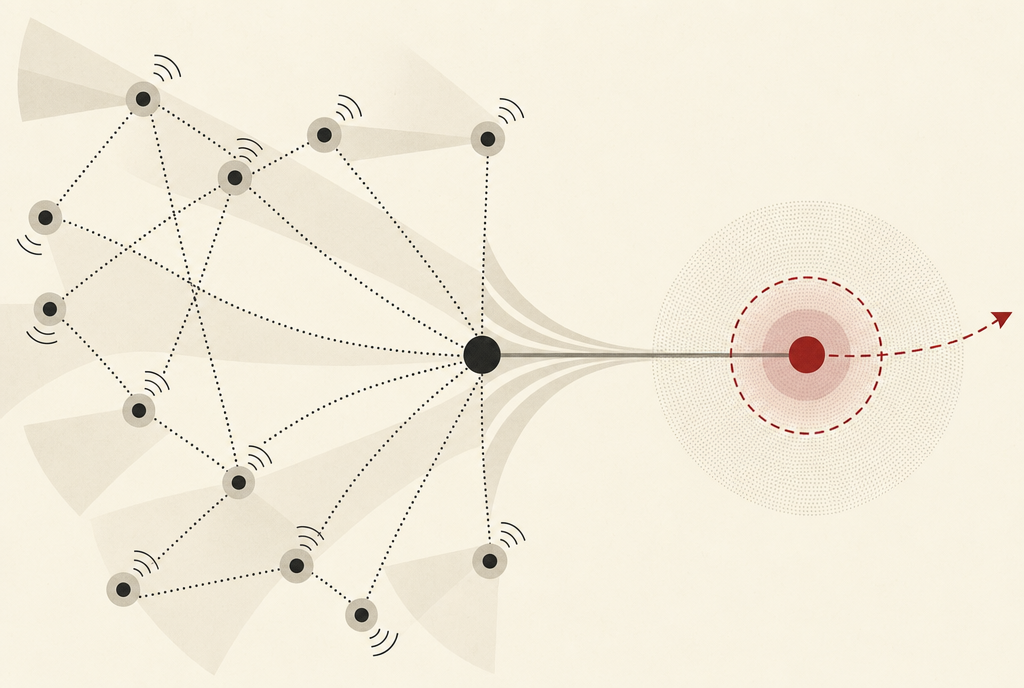
This research delves into the realm of passive wireless sensor network tracking, focusing on adaptive estimation and control. Existing models typically rely on a fixed Kalman framework for data fusion, assuming linear and time-invariant conditions. However, these models struggle when faced with nonlinear measurement dynamics and sensor dropout.
To address these limitations, the study introduces an adaptive hybrid fusion method, which combines predictive state extrapolation with dynamic gain adjustment. This approach employs an Extended Kalman Filter structure to manage tracking instability and high latency during network changes. A key challenge lies in synchronizing distributed nodes and timing communication cycles accurately.
The primary goal is to improve locating precision and stability, even in the presence of sensor absence. The simulation utilizes MATLAB and Simulink, with predefined network topology and node distribution. Key parameters include root mean square error (RMSE), latency, and link quality, which reflect dynamic response within practical ranges determined through sensitivity analysis on node density.
Data generation follows an iterative simulation approach, ensuring consistent update cycles. Data processing involves filtering and normalization techniques to eliminate outlier interference. Evaluation metrics include RMSE accuracy, latency response, and throughput utilization. The results demonstrate a significant improvement, with RMSE reduced from 0.64 to 0.41 and latency decreased from 290 to 180 ms after incorporating a Convolutional Neural Network (CNN) and Bidirectional Long Short-Term Memory (BiLSTM)-based feature extraction module into the adaptive sensor fusion and Extended Kalman Filter-based tracking framework.
These findings indicate enhanced network reliability, with stability (ξ₈) increasing from 0.71 to 0.89, signaling a stronger dynamic response under practical conditions. The authors acknowledge no external funding for this work and declare no competing interests. The research was conducted by the Departments of Electronics and Communication Engineering at Rajalakshmi Engineering College and E.G.S.
Pillay Engineering College, both located in Tamil Nadu, India. This article is licensed under a Creative Commons Attribution-NonCommercial-NoDerivatives 4.0 International License, allowing non-commercial use, sharing, distribution, and reproduction, provided appropriate credit is given to the original authors and source, and any adapted material is properly credited.
Written by urgent.news from Scientific Reports's reporting — not their text. Machine-written — may contain errors; check the original before relying on it.