New Observatory Captures More Than Half a Million Galaxies in a Single Image
The Vera C. Rubin Observatory is off to a fantastic start The post New Observatory Captures More Than Half a Million Galaxies in a Single Image appeared first on Nautilus .
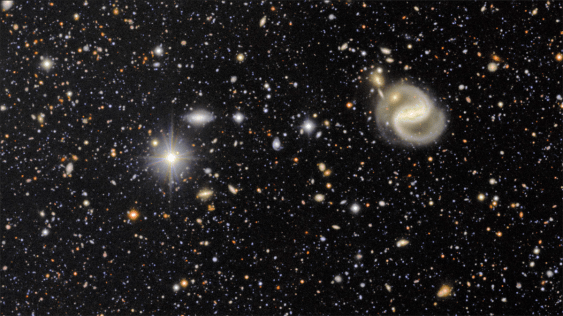
The Vera C. Rubin Observatory, situated in Chile, has made a striking debut with an impressive image showcasing more than half a million galaxies and more than 75,000 stars. The observatory's largest camera, weighing over three tons, is capable of capturing 3,200-megapixel pictures so detailed that hundreds of ultra-high-definition screens would be required to display them fully.
Since its launch in 2024, the Rubin Observatory has been mapping the southern sky through a 10-year project called the Legacy Survey of Space and Time. Among its recent achievements, the observatory has captured an extensive series of photographs of the Cosmic Evolution Survey Deep Field (COSMOS field), a highly galaxy-rich region previously observed by the Hubble Space Telescope in 2003.
The COSMOS field has been scrutinized by numerous telescopes worldwide, observing it across various wavelengths beyond the visible spectrum. The observatory's focus on this well-studied region is twofold: firstly, the wealth of prior observations makes it an ideal reference point for comparison with the new telescope's measurements; secondly, the Rubin Observatory's long-term goal of creating a time-lapse record of the universe necessitates repeated visits to the COSMOS field to add temporal dimension to existing data.
Rubin Observatory director Bob Blum stated that the COSMOS deep image is merely the beginning, as extensive observations over the next few years will reveal transient and variable objects, providing valuable data for further scientific study.
Written by urgent.news from Nautilus's reporting — not their text. Machine-written — may contain errors; check the original before relying on it.