Hybrid attack: Drone with explosives at the airport - Was it Russia?
Last year, Chancellor Merz pointed to Russia after drone sightings at German airports. This time, things are different after finding a drone with explosives at Leipzig/Halle Airport.
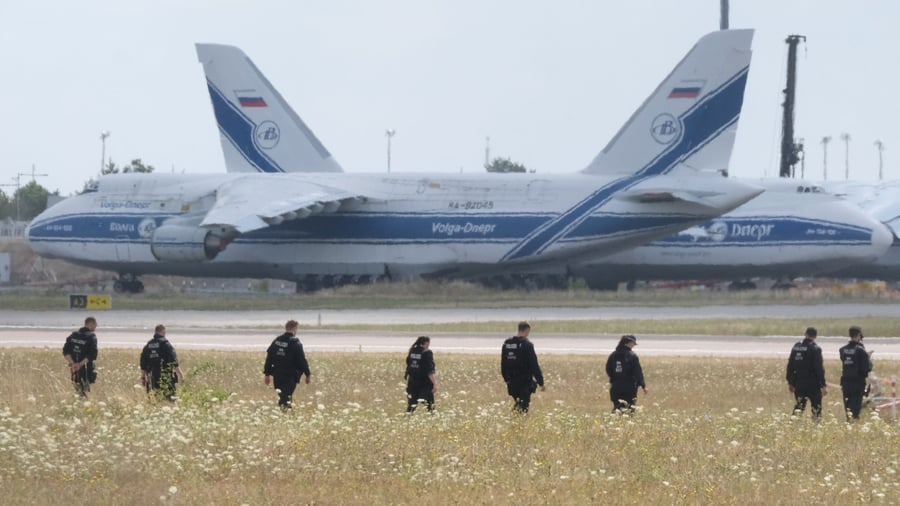
After the discovery of a drone with explosives, lacking a functioning detonator, at Halle/Leipzig Airport, many experts are quickly pointing to Russia as the possible culprit. Federal Interior Minister Alexander Dobrindt (CSU) is more reserved, referring to a "hybrid" attack by "foreign powers". Just last year, Chancellor Friedrich Merz (CDU) had alleged that Kremlin chief Vladimir Putin wanted to test Germany. The pros and cons of Russian involvement in this incident are numerous, as outlined below.
The current state of investigation involves the Federal Prosecution Office, who are looking into the suspected attempt to cause a bomb explosion and the dangerous interference in air traffic. The Federal Office found a drone equipped with explosives and a detonator near Ukrainian transport planes at Leipzig/Halle Airport. The drone was subsequently shot down by a contractor, causing a subsequent aircraft to collide with an unknown smaller flying object, possibly a second drone.
Some experts promptly accused Russia, pointing to Russia's developed drone technology and its threats against Western aid to Ukraine. Russia's former President Dmitry Medvedev, who still wields influence as Vice-Chairman of the National Security Council, placed the listed companies as "potential targets for Russian forces". Russia's ex-Military Intelligence chief GRU is often blamed for various operations in the West.
There are numerous accusations against Russia for hybrid attacks. One notable example is the 2014 explosion at a Czech munitions depot, for which the Prague government blamed the GRU. This year's case has also brought back memories: In 2024, a mail package exploded at a DHL logistics center in Leipzig. Security circles speculate that the package was placed on orders from Russia.
In Lithuania, five suspected perpetrators are currently on trial, accused of sending packages containing homemade explosives. It is alleged that these actions were organized by individuals with connections to the GRU.
However, arguments against Russian involvement exist. Russian President Vladimir Putin has categorically dismissed accusations that Russia would want to attack a NATO member state. He also dismissed previous year's accusations against Russia, stating that they were meant to further escalate tensions and encourage Europe to increase defense spending, thus diverting attention from other problems.
Medvedev even suggested that these activities could be the work of a pro-Russian underground movement in countries aimed at destabilizing life in the EU. He also acknowledged that these activities could be the work of rowdies seeking to annoy their authorities. Finally, he predicted that it was crucial for the short-sighted Europeans to experience the danger of war firsthand.
Moscow's reaction to the current case is a claim that it is a "provocation" by Kiev to stir anti-Russian hysteria in Germany. Ukraine and European militarists aim to prepare society for a war against Russia, the Russian embassy in Berlin claimed. The telegram channel "Maester", popular among many Russians for its analyses, stated that it is irrelevant whether Ukrainian or European "falkens" (hawks) are behind the action.
The key point is the trend towards conflict escalation by Kiev and the EU. Kremlin spokesperson Dmitry Peskow also dismissed allegations of Russian involvement, as did many Russians in response to Chancellor Merz's claims about the drones.
Written by urgent.news from Handelsblatt's reporting — not their text. Machine-written — may contain errors; check the original before relying on it.