Geometric constraints and cognitive inputs jointly shape emergent brain dynamics and topology
How the brain's physical geometry gives rise to its flexible functional repertoire remains a central question in neuroscience. Here, we trained three classes of recurrent neural networks (RNNs) on a working-memory task, forming a graded hierarchy of spatial constraints: Vanilla RNNs (no spatial constraints), Masked RNNs (projection constraints limiting where information enters and leaves the…
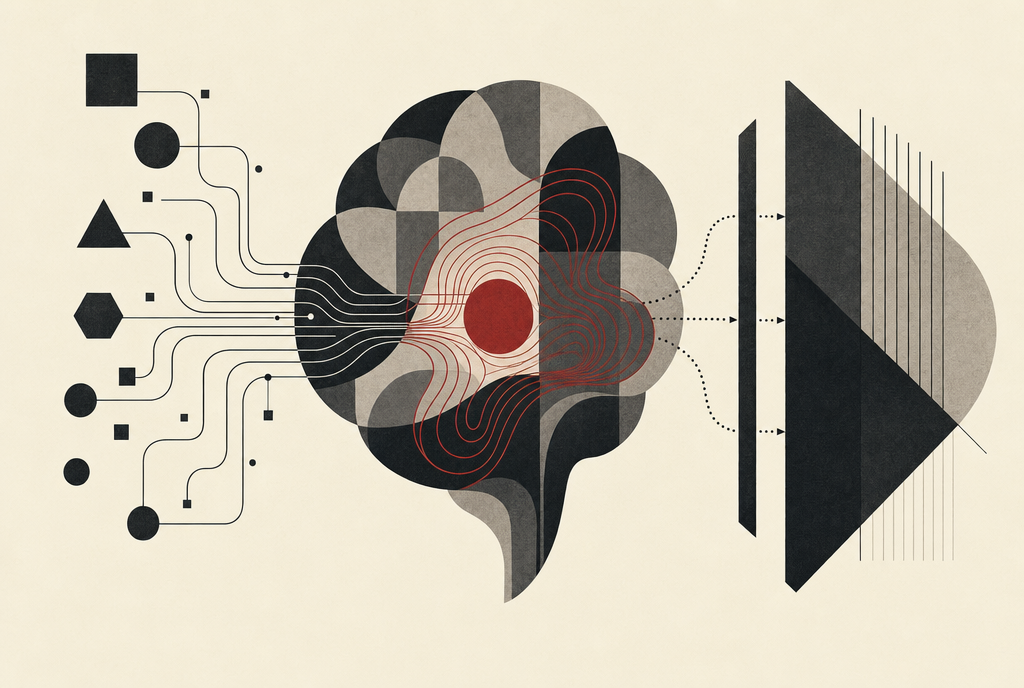
The complex interplay between physical geometry and cognitive inputs in shaping brain dynamics is a significant question in neuroscience. To investigate this, researchers trained three types of recurrent neural networks (RNNs) on a working-memory task. These RNNs included Vanilla RNNs with no spatial constraints, Masked RNNs with projection constraints, and biophysical RNNs (bioRNNs) that incorporated both projection constraints and the brain's inter-regional Euclidean geometry.
After training, the researchers evaluated which RNN class could best predict empirical fMRI activity. Remarkably, only the bioRNNs achieved this feat and organized their dynamics into a spatial pattern that mirrored the brain's principal hierarchy, specifically the sensorimotor-association axis. Furthermore, the researchers observed that the bioRNNs' ability to predict brain activity evolved through a specific process: geometry was initially established, followed by a partial retraction as the networks became proficient in the task.
Interestingly, the emergence of brain-like topological features in bioRNNs coincided with their increasing proficiency at the task, even as they retained their ability to predict brain activity. This study reveals that physical geometry and cognitive inputs are distinct yet complementary forces in the brain. While geometry imposes constraints on possible brain dynamics, cognitive inputs guide which dynamics ultimately manifest.
Ultimately, topology serves as a framework for the physically embedded brain to balance wiring costs and computational demands.
Written by urgent.news from bioRxiv's reporting — not their text. Machine-written — may contain errors; check the original before relying on it.