Whoops, Apocalypse! Why Five Conflicts Could Become One World War | Opinion
The wars in Iran and Ukraine have created a plausible path toward the doomsday scenarios of 1914 and 1939.
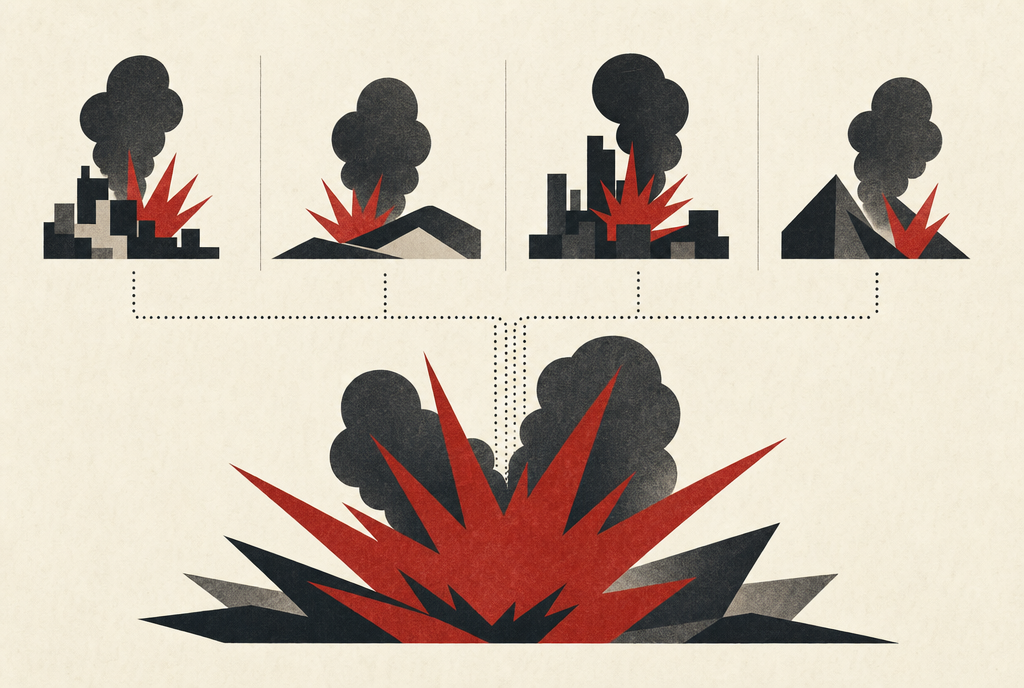
The United States and Iran's conflict started as a regional dispute with worldwide economic repercussions. Although it could settle as such, there exists a more ominous scenario: as seen in 1914, numerous rational decisions by global powers might culminate in a worldwide catastrophe. Current and potential disputes - Ukraine, the Gulf, Yemen, Lebanon, and Taiwan - could intertwine, causing every major power to become entangled in multiple conflicts simultaneously.
This global tension could alter Russia, China, Europe, and the United States' decisions, leading to interdependent escalation.
If the stalemate persists, Iran's harassment of the Strait of Hormuz and America's Gulf allies endures. Iran's Houthi proxies continue obstructing traffic through the Bab el-Mandeb, putting both access points to the Arabian Peninsula at constant risk. The U.S. carries out isolated strikes against Iranian military assets and proxies, maintaining that diplomacy remains a choice.
Tehran insists on its right to govern tax shipping through Hormuz. Meanwhile, the global economic fallout accumulates. Oil and liquefied natural gas flow through the Persian Gulf is vital for energy markets, and the Red Sea is one of the primary conduits connecting Europe and Asia. Each week of obstruction raises insurance premiums, extends shipping routes, heightens transportation costs, and fuels global inflation.
Fertilizer supplies tighten, aviation fuel escalates in price, and supply chains malfunction. To regain freedom of navigation, military strategists begin evaluating how to impose greater pressure not only on Iran but on the network through which it exerts power throughout the region.
The Houthi challenge remains the most immediate concern. For over a decade, Saudi Arabia failed to defeat them and now lacks the will to wage another war alone. However, as long as the Houthis can close the Bab el-Mandeb, they can threaten one of the world's main commercial routes, disrupt Suez Canal traffic, and deprive Egypt of crucial hard currency.
They must be somehow subdued. Hezbollah presents a parallel chance in Lebanon. Syria collaborates in weakening Iran's supply lines and military infrastructure, while the Lebanese state confronts Hezbollah from within. What had been perceived as an Israeli issue is now recognized as an effort to reclaim Lebanese sovereignty. The Popular Mobilization Forces then escalate Iraq into a third front.
As Iran-backed militias intensify attacks on American bases, Kurdish forces and coalition supply lines, Washington augments its presence in Iraqi Kurdistan to safeguard coalition operations, empower the Kurds, and retain the capacity to strike the PMF throughout Iraq. Iraq once again becomes a battlefield. NATO now joins the U.S., seizing Kharg Island, Iran's vital oil depot, and Qeshm Island, essential to its control of Hormuz.
Neither operation induces Iranian capitulation or restores unobstructed passage through the Gulf. Iran is shielded by mountains, vast distances, and limited avenues of approach, but its regional network grows increasingly exposed. The coalition may still claim it is not aiming for regime change. Tehran, Beijing, and Moscow realize they share a common strategic interest: none desires to see the Iranian regime fall to American military pressure, with the U.S. gaining increased influence over one of the world's most important energy corridors.
All acknowledge that a prolonged conflict drains military resources, industrial production, and political attention that Washington could otherwise allocate. China openly becomes a U.S. military rival. For Moscow, the military alliance with Tehran from the Ukraine war strengthens further as Russia expands deliveries of air-defense systems, electronic warfare capabilities, intelligence, advisors, and advanced military technologies.
Every extra month the U.S. focuses on the Gulf bolsters Moscow's strategic position in Ukraine and toward Europe. North Korea fits in naturally, having previously shown its readiness to swap artillery ammunition, ballistic missiles, and manpower for Russian economic aid and advanced military technology.
Thus, China, Russia, Iran, and North Korea form a precarious strategic alliance—a loose Axis—mutually supporting each other because each gains from draining the U.S. and its allies' military and political capacity. The longer the Middle Eastern crisis endures, the more appealing it becomes for opposing powers to exploit Washington's distraction.
Ukraine's stabilization of the front and its ability to strike deep into Russia's military economy increases costs for Kyiv. American and allied stocks of air-defense interceptors, precision-guided munitions, and long-range missiles are increasingly redirected to protect the Gulf and Red Sea, leaving fewer for Ukraine. Putin responds accordingly.
Written by urgent.news from Newsweek's reporting — not their text. Machine-written — may contain errors; check the original before relying on it.